
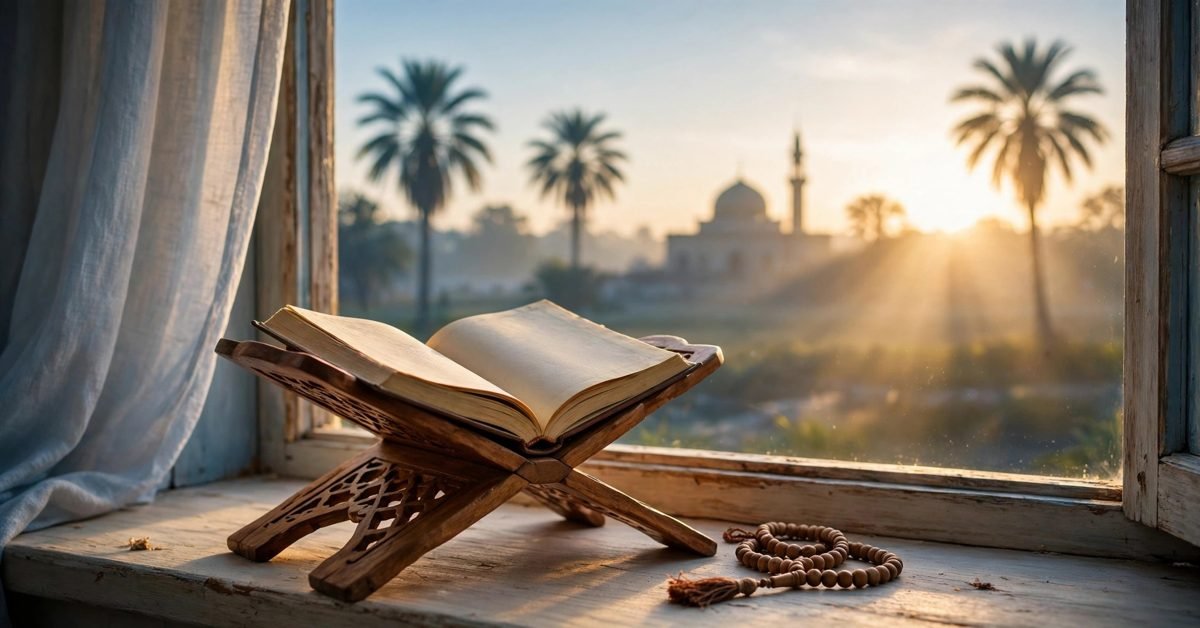
Morning and evening adhkar are the short, authentic remembrances the Prophet ﷺ taught us to say at the start and end of each day — a simple 10-minute routine that protects your day and night, fills them with reward, and keeps your heart connected to Allah. This guide gives you the essential adhkar, with Arabic, transliteration and translation, so you can start today.
What Are Morning and Evening Adhkar?
“Adhkar” is the plural of “dhikr” — remembrance of Allah: short duas and verses from the Quran and Sunnah, recited after Fajr in the morning and after ‘Asr in the evening.
Allah commands this rhythm of remembrance in the Quran:
فَسُبْحَانَ اللَّهِ حِينَ تُمْسُونَ وَحِينَ تُصْبِحُونَ
“Fa subḥānallāhi ḥīna tumsūna wa ḥīna tuṣbiḥūn.”
“So exalted is Allah when you reach the evening and when you reach the morning.” (Surah Ar-Rum 30:17)
The morning adhkar begin your day with Allah’s name; the evening adhkar close it the same way.
When Should You Recite Them?
Recite the morning adhkar after Fajr until sunrise, and the evening adhkar after ‘Asr until Maghrib. If you miss the window, recite them later anyway — a late dhikr is far better than none at all. Tie them to a prayer you already pray: after Fajr, before you pick up your phone; after ‘Asr, before the evening rush.
The Essential Morning and Evening Adhkar
Start with these six, which carry the greatest rewards in the authentic hadith, and add more over time.
1. The Opening Dua
Begin with the dua for entering the morning. In the evening, the ending changes slightly:
اللَّهُمَّ بِكَ أَصْبَحْنَا وَبِكَ أَمْسَيْنَا وَبِكَ نَحْيَا وَبِكَ نَمُوتُ وَإِلَيْكَ النُّشُورُ
“Allāhumma bika aṣbaḥnā, wa bika amsaynā, wa bika naḥyā, wa bika namūt, wa ilaykan-nushūr.”
“O Allah, by You we enter the morning and by You we enter the evening, by You we live and by You we die, and to You is the resurrection.” (Sunan Abi Dawud)
In the evening, say:
اللَّهُمَّ بِكَ أَمْسَيْنَا وَبِكَ أَصْبَحْنَا وَبِكَ نَحْيَا وَبِكَ نَمُوتُ وَإِلَيْكَ الْمَصِيرُ
“Allāhumma bika amsaynā, wa bika aṣbaḥnā, wa bika naḥyā, wa bika namūt, wa ilaykal-maṣīr.”
“O Allah, by You we enter the evening and by You we enter the morning, by You we live and by You we die, and to You is the return.”
2. Ayatul Kursi
Recite Ayatul Kursi (Surah Al-Baqarah 2:255) once, morning and evening. It is the greatest verse in the Quran, affirming Allah’s perfect knowledge and power over all creation.
3. The Three Quls — Three Times Each
Recite Surah Al-Ikhlas, Surah Al-Falaq and Surah An-Nas three times each, morning and evening. ‘Abdullah ibn Khubayb (may Allah be pleased with him) reported that the Prophet ﷺ told him to recite them three times every morning and evening, saying: “They will suffice you against everything.” (Jami’ at-Tirmidhi 3575; Sunan Abi Dawud 5082)
Al-Ikhlas affirms pure faith in Allah, while Al-Falaq and An-Nas seek refuge from every outer and inner harm.
4. The Dua of Protection — Three Times
بِسْمِ اللَّهِ الَّذِي لَا يَضُرُّ مَعَ اسْمِهِ شَيْءٌ فِي الْأَرْضِ وَلَا فِي السَّمَاءِ وَهُوَ السَّمِيعُ الْعَلِيمُ
“Bismillāhil-ladhī lā yaḍurru ma’asmihī shay’un fil-arḍi wa lā fis-samā’, wa Huwas-Samī’ul-‘Alīm.”
“In the name of Allah, with whose name nothing on earth or in heaven can cause harm, and He is the All-Hearing, the All-Knowing.”
‘Uthman ibn ‘Affan (may Allah be pleased with him) reported that the Prophet ﷺ said: “Whoever says this three times in the morning and evening, nothing will harm him.” (Sunan Abi Dawud 5088; Jami’ at-Tirmidhi 3388)
5. Sayyid al-Istighfar — The Master Dua for Forgiveness
اللَّهُمَّ أَنْتَ رَبِّي، لَا إِلَهَ إِلَّا أَنْتَ، خَلَقْتَنِي وَأَنَا عَبْدُكَ، وَأَنَا عَلَى عَهْدِكَ وَوَعْدِكَ مَا اسْتَطَعْتُ، أَعُوذُ بِكَ مِنْ شَرِّ مَا صَنَعْتُ، أَبُوءُ لَكَ بِنِعْمَتِكَ عَلَيَّ وَأَبُوءُ لَكَ بِذَنْبِي، فَاغْفِرْ لِي، فَإِنَّهُ لَا يَغْفِرُ الذُّنُوبَ إِلَّا أَنْتَ
“Allāhumma Anta Rabbī, lā ilāha illā Ant, khalaqtanī wa anā ‘abduk, wa anā ‘alā ‘ahdika wa wa’dika mastaṭa’t, a’ūdhu bika min sharri mā ṣana’t, abū’u laka bini’matika ‘alayya wa abū’u laka bidhanbī, faghfir lī, fa innahū lā yaghfirudh-dhunūba illā Ant.”
“O Allah, You are my Lord, there is none worthy of worship except You. You have created me, and I am Your servant, and I am faithful to Your covenant and promise as much as I can. I seek refuge in You from the evil of what I have done. I acknowledge Your blessings upon me, and I admit my sins. So forgive me, for none forgives sins except You.”
The Prophet ﷺ called this the most superior way of asking for forgiveness: whoever recites it with firm faith during the day and dies before evening is among the people of Paradise, and likewise at night. (Sahih al-Bukhari 6306)
6. SubhanAllahi wa Bihamdihi — One Hundred Times
سُبْحَانَ اللَّهِ وَبِحَمْدِهِ
“Subḥānallāhi wa biḥamdih.”
“Glory be to Allah and praise be to Him.”
Abu Hurairah (may Allah be pleased with him) reported that the Prophet ﷺ said: “Whoever says this one hundred times in the morning and in the evening, no one will come on the Day of Resurrection with anything better than what he brings, except one who said the same or more.” (Sahih Muslim 2692)
It takes about two minutes — the easiest hundred rewards of your day.
A Simple 10-Minute Routine
Here is how the six adhkar fit together, morning and evening:
1. Opening dua — once.
2. Ayatul Kursi — once.
3. The Three Quls — three times each.
4. The dua of protection — three times.
5. Sayyid al-Istighfar — once.
6. SubhanAllahi wa bihamdihi — one hundred times.
If ten minutes feels like a lot, start with just the opening dua, Ayatul Kursi, the Three Quls and the dua of protection — about three minutes. Do that for a week, then add one more.
Common Mistakes to Avoid
Rushing without understanding. Dhikr is remembrance, not a race. Read the translation until the meaning settles in your heart.
Waiting for the “perfect” time. Missed Fajr’s window? Recite after sunrise. Missed ‘Asr’s window? Recite before bed.
Giving up after missing a day. Missing one morning cancels nothing. Simply start again the next morning.
Frequently Asked Questions
Can I recite the morning adhkar after sunrise if I oversleep?
Yes. The best time is after Fajr until sunrise, but reciting later in the morning is still rewarded.
Can I recite the evening adhkar after Maghrib?
Yes. The best time is after ‘Asr until Maghrib, but if you forget, recite them when you remember.
Do I have to recite the adhkar in Arabic?
The reward promised in the hadith is for the words as the Prophet ﷺ taught them, so Arabic is best. If you are still learning, recite in Arabic from this guide while reading the translation.
How long do the morning and evening adhkar take?
The core routine here takes about ten minutes; the beginner’s version takes about three minutes.
Can children recite the morning and evening adhkar?
Absolutely. Start them with the Three Quls and the dua of protection, which are short and easy to memorise.
What if I miss a day of adhkar?
Nothing is lost. Simply resume the next morning or evening.
Start tonight or tomorrow morning — whichever comes first. Ten minutes, twice a day, and your whole day and night are framed by the remembrance of Allah. To learn the Quran with Tajweed from qualified teachers, book a free trial class with Noor Academy Pakistan at nooracademypakistan.com.
Leave a Reply