
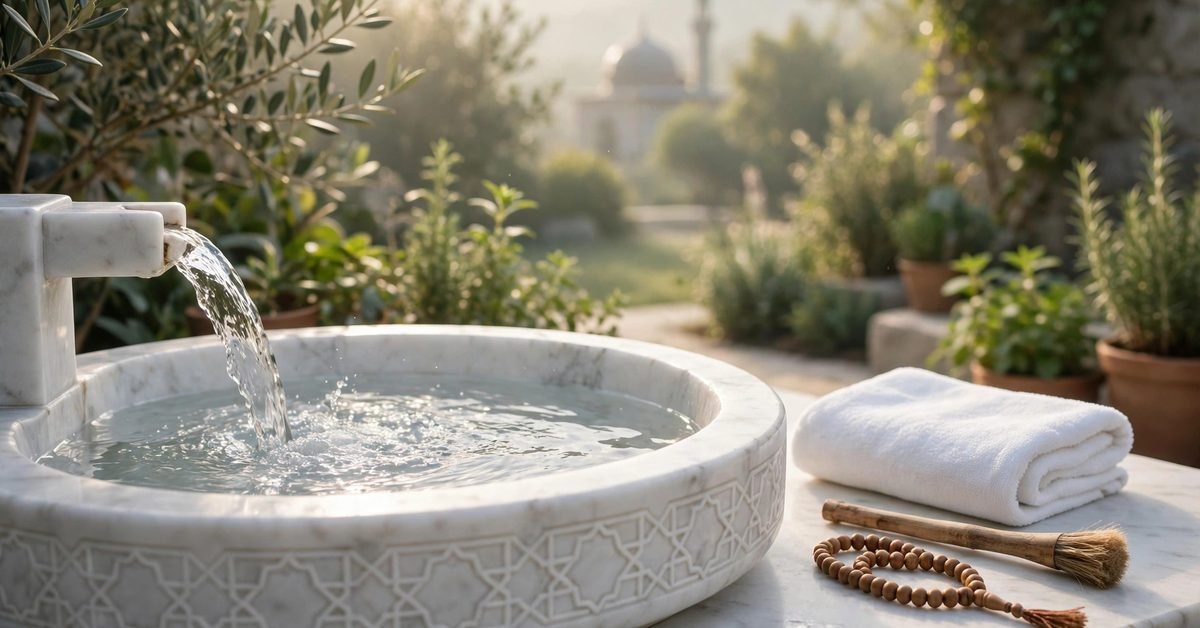
Ghusl is the full ritual bath that restores a Muslim to a state of purity after major impurity. This guide explains how to perform ghusl correctly: make the intention in your heart, wash the hands and private parts, perform wudu, pour water over the head three times, then wash the whole body so no spot remains dry. Done this way it takes only a few minutes — even under an ordinary shower — and afterwards you may pray, touch the Quran, and fast without any doubt.
What Is Ghusl?
Wudu washes specific parts of the body for prayer; ghusl washes the entire body. It lifts the state of major ritual impurity (janabah) that follows marital relations or a wet dream, and it is also required after menstruation and postnatal bleeding end. Allah commands this purification in the Quran:
وَإِن كُنتُمْ جُنُبًا فَاطَّهَّرُوا
“Wa in kuntum junuban faṭṭahharū.”
“And if you are in a state of janabah, then purify yourselves.” (Surah Al-Ma’idah 5:6)
Ghusl is not about soap, shampoo, or scrubbing hard. Its essence is simple: intention plus water reaching every part of the body.
When Is Ghusl Required?
Ghusl becomes obligatory in these situations:
- Janabah — after marital relations, or after a wet dream in which fluid is discharged.
- After menstruation ends — before resuming prayer and fasting.
- After postnatal bleeding (nifas) ends — when the bleeding stops, within a maximum of forty days.
Ghusl is also recommended before Friday and Eid prayers, and for a person newly embracing Islam. The simple rule: if major impurity has occurred, perform ghusl before your next prayer.
How to Perform Ghusl: The Sunnah Method, Step by Step
‘Aishah (may Allah be pleased with her) described how the Prophet ﷺ performed ghusl:
“Whenever the Prophet ﷺ took a bath after janabah, he started by washing his hands and then performed ablution like that for the prayer. After that he would put his fingers in water and move the roots of his hair with them, and then pour three handfuls of water over his head and then pour water all over his body.” (Sahih al-Bukhari 248)
Another narration from Maymunah (may Allah be pleased with her) adds that he washed off any impurity, performed wudu but delayed washing his feet, and washed them at the end after stepping aside (Sahih al-Bukhari 249). Together, the narrations give the complete Sunnah method:
1. Make the intention. Intention is in the heart — simply intend that this bath is ghusl for purification. No words need to be spoken aloud.
2. Say “Bismillah” and wash your hands up to the wrists, three times if easy.
3. Wash the private parts and remove any impurity, then wash your hands again.
4. Perform wudu. Do a complete wudu as for prayer, including rinsing the mouth and nose. If water collects around your feet, you may wash the feet at the end, following Maymunah’s narration — or with the wudu. Both ways are reported.
5. Wet the roots of your hair. Dip your fingers in water and run them through your hair so the water reaches the scalp.
6. Pour water over your head three times. Three handfuls, or three pours under the shower, making sure the water reaches the scalp all over.
7. Wash the whole body. Pour water over the rest of your body, right side then left, rubbing it over your skin. Check the places people commonly miss: inside the navel, behind the ears, between the toes, under the arms, and skin folds. Under a shower, simply stand under the water and rub it over your whole body from head to toe.
The Obligatory Minimum
If you are short on time, remember what is strictly required: the intention, and water reaching the entire body, including the hair. A thorough shower done with the intention of ghusl fulfils the obligation. Scholars differ on whether rinsing the mouth and nose is obligatory or Sunnah in ghusl; since the Sunnah method includes them, never skip them deliberately and you cover every view.
Ghusl for Women: Do Braids Need Undoing?
No — provided the water reaches the roots of the hair. Umm Salamah (may Allah be pleased with her) asked the Prophet ﷺ about her tightly plaited hair, and he replied:
“No, it is enough for you to throw three handfuls of water on your head and then pour water over yourself, and you shall be purified.” (Sahih Muslim 330a)
So a woman with braids does not have to undo them for ghusl, as long as she pours water over her head three times and makes sure it reaches the scalp. The same applies after menstruation and postnatal bleeding.
Common Mistakes to Avoid
Leaving a spot dry. The most common mistake is rushing and missing a patch of skin. Rub the water over your whole body — ghusl is complete only when water has reached everywhere.
Forgetting the intention. A normal shower without the intention of ghusl is just a shower. Pause for one second beforehand and intend purification.
Delaying ghusl past a prayer. Once ghusl is required, do not let a prayer time pass without performing it. If water is unavailable or harmful to use, tayammum is the substitute — but water should be used whenever you can.
Frequently Asked Questions
Does ghusl replace wudu? Yes. A Sunnah ghusl includes wudu, so you may pray afterwards without a separate wudu — unless something breaks your wudu afterwards.
Can I perform ghusl under a shower? Yes. Follow the steps above and make sure the water reaches your whole body; no particular vessel is required.
Do I need to wash my hair fully, or just the roots? The water must reach the hair and scalp. Pouring three times over the head and rubbing the water through achieves this, whether the hair is loose or braided.
Is soap or shampoo part of ghusl? No — optional for general cleanliness. What matters is intention and water reaching the whole body.
What if I realise after ghusl that one spot stayed dry? Simply wash that spot; if it is a large area or you are unsure, repeat the ghusl.
Learning the acts of worship correctly is the first step to practising them with confidence. If you or your children would like to learn the Quran with proper Tajweed and the essentials of worship step by step, Noor Academy Pakistan offers live one-to-one online classes with qualified teachers — beginning with two free trial classes, with no obligation. Visit nooracademypakistan.com to book your free trial today, In sha Allah.
Leave a Reply