
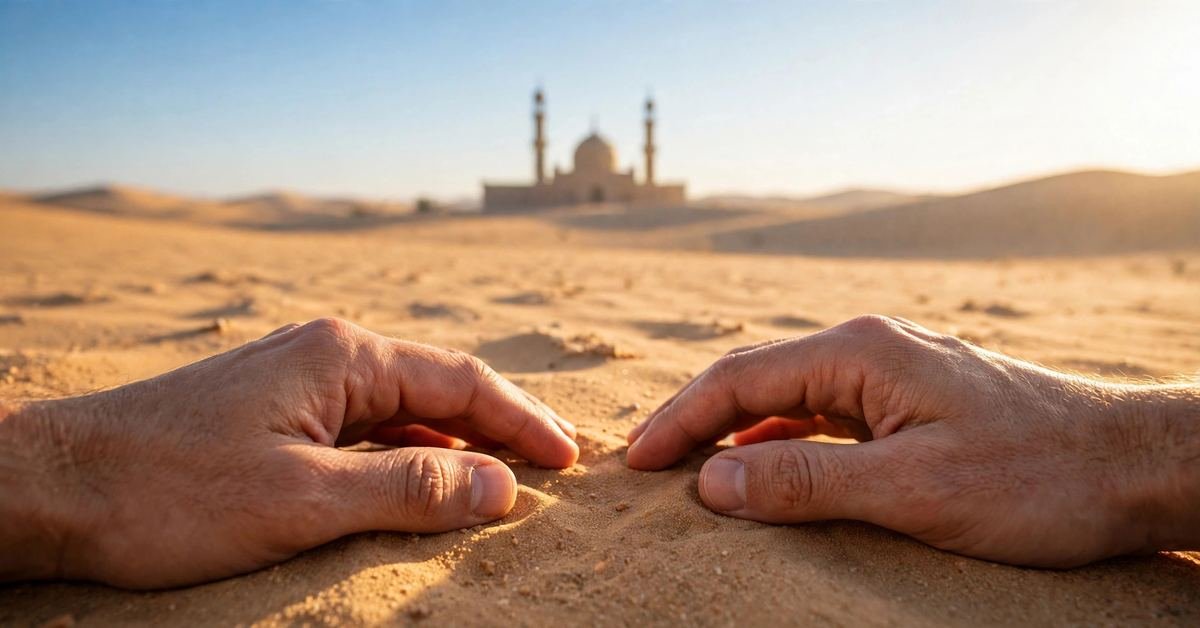
No water? You can still pray. Tayammum — dry ablution with clean earth — replaces wudu and ghusl when water is unavailable or cannot be used, and it takes less than a minute to perform. Here is exactly when it applies and how to do it correctly, step by step.
What Is Tayammum?
Tayammum is the Islamic dry ablution: wiping the face and hands with clean earth, sand or dust when water is not available. It is not a lesser substitute or a last resort to feel guilty about — it is a concession Allah Himself gave us, directly in the Quran:
فَتَيَمَّمُوا صَعِيدًا طَيِّبًا فَامْسَحُوا بِوُجُوهِكُمْ وَأَيْدِيكُمْ
“Fatayammamoo sa’eedan tayyiban famsahoo biwujoohikum wa aydeekum.”
“…then seek clean earth and wipe over your faces and your hands [with it]. Indeed, Allah is ever Pardoning and Forgiving.” (Surah An-Nisa 4:43)
The Prophet ﷺ explained how far this concession reaches:
الصَّعِيدُ الطَّيِّبُ وَضُوءُ الْمُسْلِمِ وَلَوْ إِلَى عَشْرِ سِنِينَ
“As-Sa’eedut-tayyibu wudoo’ul-Muslimi wa law ila ‘ashri sineen.”
“Clean earth is the ablution of the Muslim, even for ten years (if he does not find water); but when you find water, you should make it touch your skin, for that is better.” (Sunan Abi Dawud 332; graded Sahih)
Ten years is not a literal limit — it means as long as water is unavailable, tayammum keeps you in a state of purity. The moment water becomes available, wudu or ghusl returns as the duty.
When Can You Perform Tayammum?
Tayammum is allowed in these situations:
No water at all. You are travelling, camping, or in a place where no water can be found, and the prayer time has come.
Water is too far away. Water exists but is so far that fetching it would make you miss the prayer time.
Water will harm you. You are ill, injured, or it is bitterly cold and using water would worsen your condition or endanger your health.
You need the water to survive. The only water available is needed for drinking, and using it for wudu would leave you without enough to drink.
Water is available but you cannot reach it. For example, a person with a disability or someone whose movement is restricted.
Tayammum replaces both wudu and ghusl. If you need a full bath (ghusl) but cannot find water, one tayammum covers it — this is exactly the situation the Prophet ﷺ addressed when he taught Ammar ibn Yasir (may Allah be pleased with him).
How to Perform Tayammum — Step by Step
The Prophet ﷺ demonstrated tayammum himself. When Ammar ibn Yasir (may Allah be pleased with him) told him he had rolled in the dust after becoming junub on a journey, the Prophet ﷺ said it would have been enough to do this:
فَضَرَبَ النَّبِيُّ صلى الله عليه وسلم بِكَفَّيْهِ الأَرْضَ، وَنَفَخَ فِيهِمَا، ثُمَّ مَسَحَ بِهِمَا وَجْهَهُ وَكَفَّيْهِ
“Fadaraban-Nabiyyu ﷺ bikaffayhil-arda, wa nafakha feehima, thumma masaha bihima wajhahu wa kaffayh.”
“The Prophet ﷺ then stroked lightly the earth with his hands and then blew off the dust and passed his hands over his face and hands.” (Sahih al-Bukhari 338)
Follow these five steps:
1. Make the intention (niyyah)
Intend in your heart that you are performing tayammum to purify yourself for prayer. The intention is made in the heart — you do not need to say it out loud.
2. Say Bismillah
Say “Bismillah” before beginning, just as you would before wudu.
3. Strike the clean earth once with both palms
Place both palms flat on clean earth, sand, dust, or a clean stone or wall that has dust on it. One strike is enough.
4. Blow off the excess dust
Gently blow on your hands to remove the loose dust, exactly as the Prophet ﷺ did in the hadith above. Your hands should carry only a light trace of dust — tayammum is about wiping, not covering yourself in soil.
5. Wipe your face, then your hands
Wipe your whole face once with both palms. Then wipe the back of your right hand with your left palm, and the back of your left hand with your right palm. That is the complete tayammum — you are now in a state of purity and can pray.
A note on differences: scholars differ on whether the hands are wiped to the wrists or up to the elbows, and whether one strike or two are used. The Prophet’s ﷺ demonstration in Sahih al-Bukhari 338 — one strike, face and hands — is the simplest and most widely followed practice. If you follow a particular school of thought, follow its guidance on this detail.
What Can You Use for Tayammum?
The Quran says “clean earth” (sa’eedan tayyiba). Scholars agree this includes:
- Clean soil, sand or dust — the most common and best option.
- A stone, rock or brick — anything from the earth that has dust on it.
- A clean wall or floor — if it has a layer of dust on it.
What you cannot use: anything impure (najis), or a surface with no dust at all, such as polished glass or clean metal. The surface must be clean — “tayyib” means pure and wholesome.
What Breaks Tayammum?
The same things that break wudu break tayammum: using the toilet, passing wind, deep sleep, and so on. Tayammum has two extra conditions that end it:
- Finding water. The moment water becomes available, your tayammum ends and you must perform wudu (or ghusl) with water before praying.
- The prayer time passing. Most scholars hold that one tayammum is for one prayer time; if a new prayer time enters, perform tayammum again.
One tayammum is enough for as many prayers as you wish within the same prayer time, and for touching the Quran and other acts that require purity.
Common Mistakes to Avoid
Rolling in the dust. Ammar ibn Yasir (may Allah be pleased with him) did this before he knew better — the Prophet ﷺ corrected him. One strike of the palms is all that is needed.
Using too much dust. If your face is covered in dirt, you have used too much. Blow off the excess first.
Skipping tayammum when water is harmful. Some people force themselves to use freezing water when ill, or delay prayer waiting for water. Tayammum is Allah’s gift of ease — use it when it applies.
Thinking tayammum is “second-class” purity. It is not. The Prophet ﷺ said the whole earth was made a place of prostration and a means of purification for him: “The earth has been made for me a place of prostration and a purifier.” (Sahih al-Bukhari 335; Sahih Muslim 521) A prayer offered with tayammum is a complete, valid prayer.
A Gift of Ease
Tayammum is one of the clearest signs of how easy Allah made this religion. Whether you are on a long journey, in a hospital bed, or in a place where water simply is not there, the door to prayer never closes. All it takes is clean earth, one strike of the hands, and a sincere intention — and you are ready to stand before Allah.
Frequently Asked Questions
Can I perform tayammum instead of ghusl?
Yes. Tayammum replaces both wudu and ghusl when water is unavailable or cannot be used. One tayammum covers the state of major impurity (janabah) as well as minor impurity.
Does one tayammum cover multiple prayers?
Yes, within the same prayer time. You can pray more than one prayer and touch the Quran with the same tayammum, as long as nothing breaks it. When a new prayer time begins, most scholars recommend performing tayammum again.
What if I find water after performing tayammum but before praying?
Your tayammum ends. Perform wudu (or ghusl) with the water and then pray.
Can I do tayammum on a wall or a stone?
Yes, if the surface has dust on it and is clean. A dusty wall, a stone, clean sand or soil — all are valid. A perfectly clean, dust-free surface such as polished glass is not.
Does tayammum work if I am sick and water would harm me?
Yes. Illness or injury that makes using water harmful is one of the main reasons tayammum was prescribed. The Quran mentions sickness explicitly alongside travel (Surah An-Nisa 4:43).
Do I need to remove my ring or watch for tayammum?
As with wudu, make sure the dust reaches the skin. If a ring is tight, move it or remove it so the wipe reaches the skin beneath it.
Start Learning Today
Purification is the first step of prayer — and prayer is the first thing we will be asked about. Learning wudu, ghusl and tayammum properly means your worship stands on a solid foundation.
Want to learn the Quran and the essentials of worship step by step? Book a free trial class at Noor Academy Pakistan — our qualified male and female teachers teach children and adults one-to-one, from Noorani Qaida to tajweed and hifz, with a personal plan for every student. Visit nooracademypakistan.com to book your free trial today.
Leave a Reply