
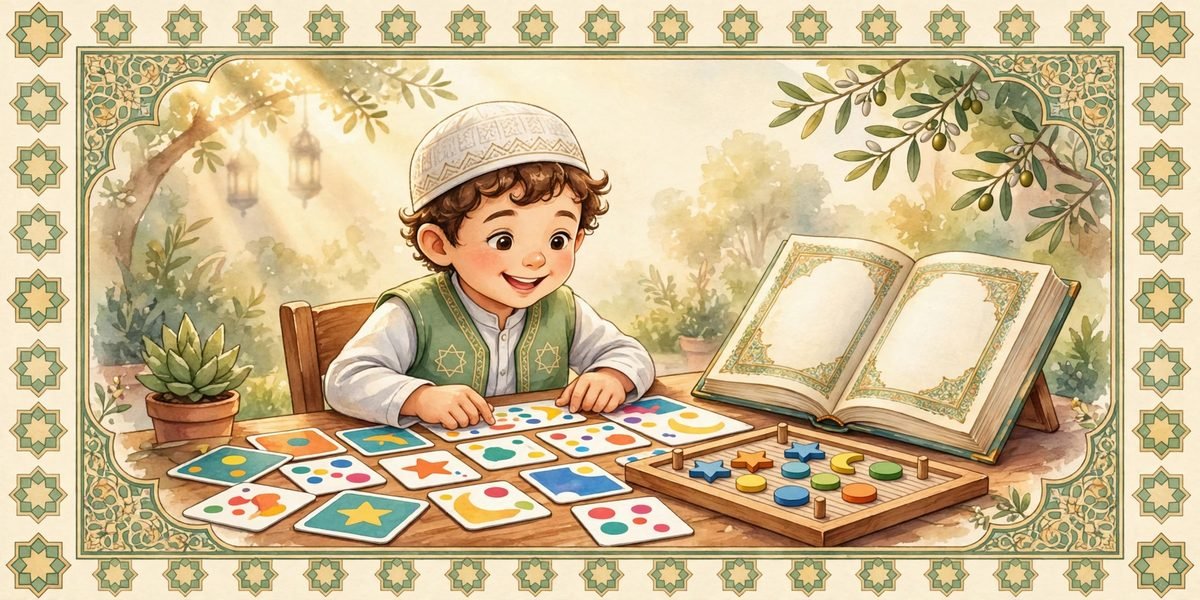
Every child who reads the Quran fluently started in exactly the same place: with 28 letters. Before tajweed, before Noorani Qaida, before the first surah, there is the Arabic alphabet — and the good news is that you can teach it at home, in ten minutes a day, with nothing more than flashcards, patience and a little play. Here is a simple, proven way to do it.
The First Word Allah Revealed Was “Read”
The very first word of revelation was a command to read:
اقْرَأْ بِاسْمِ رَبِّكَ الَّذِي خَلَقَ
“Iqra’ bismi Rabbikalladhi khalaq.”
“Read, in the name of your Lord who created.” (Surah Al-Alaq 96:1)
Reading begins with letters. When you sit with your child and teach them Alif, Ba, Ta, you are answering that first command — and the Prophet ﷺ told us where the honour in that lies:
خَيْرُكُمْ مَنْ تَعَلَّمَ الْقُرْآنَ وَعَلَّمَهُ
“Khayrukum man ta’allamal-Qur’ana wa ‘allamah.”
“The best of you are those who learn the Quran and teach it.” (Sahih al-Bukhari 5027)
Start with the 28 Letters — In Shape Families, Not in Order
Most parents teach the alphabet in order, from Alif to Ya. That works, but there is a faster way: teach the letters in shape families. Many Arabic letters share the same shape and differ only in dots, so learning them in groups halves the work.
The dot family: Ba (ب), Ta (ت), Tha (ث) and Noon (ن) are one shape with different dots. Teach them together and your child learns four letters at once.
The hook family: Jeem (ج), Ha (ح) and Kha (خ) are the same curve with a dot below, no dot, or a dot above.
The bowl family: Seen (س) and Sheen (ش), Saad (ص) and Daad (ض), Ta (ط) and Za (ظ) — each pair is the same shape, one plain and one with dots.
The stand-alone letters: Alif (ا), Daal (د), Dhaal (ذ), Ra (ر), Za (ز), Waw (و) — these never join to the letter after them. Point this out early; it saves confusion later.
Teach three or four letters a day, and the whole alphabet is covered in about a week. Then spend two more weeks revising until your child recognises every letter instantly, in any order.
7 Steps to Teach Your Child the Arabic Alphabet
1. Begin with the sounds, not the names
Children learn letters faster when they hear them first. Say the sound — “ba”, “ta”, “tha” — and let your child repeat it. Then show the written letter. Sound first, shape second, name third.
2. Use flashcards — and let your child hold them
Hold up a card, say the letter, and ask your child to repeat it. Then turn it around: let your child hold the card and “teach” you. Children remember far more when they are the teacher. Keep the cards visible on the fridge or the bedroom wall so the letters are seen all day, not just in lesson time.
3. Teach the three forms of each letter
Every Arabic letter changes shape depending on where it sits in a word — at the start, in the middle, or at the end. Do not wait until later to show this. When you teach Ba, show your child Ba at the start of a word, Ba in the middle, and Ba at the end. One letter, three shapes, learned together.
4. Turn it into a game
Games beat drills every time. Try these three:
- Letter hunt: hide flashcards around the room and ask your child to find “the letter with two dots on top” (Ta) or “the letter that looks like a boat” (Ba).
- Matching pairs: lay the cards face down and match the letter with its sound card.
- Trace and say: let your child trace each letter in sand, on a whiteboard, or with a finger in the air — and say the sound as they trace it. Movement locks memory in.
5. Connect letters to words your child already knows
Link each letter to something familiar: Ba for Bismillah, Alif for Allah, Meem for Muhammad ﷺ, Ra for Ramadan. A letter tied to a beloved word is never forgotten. This is also the moment to teach the short dua for knowledge:
وَقُل رَّبِّ زِدْنِي عِلْمًا
“Wa qul Rabbi zidni ‘ilma.”
“And say: ‘My Lord, increase me in knowledge.’” (Surah Ta-Ha 20:114)
Teach your child to say it before every lesson. It takes five seconds and it turns study into worship.
6. Keep lessons short — ten minutes is enough
A five-year-old’s attention lasts about ten minutes. Stop while your child is still enjoying it, not after they are tired. Three short lessons a week beat one long, tearful hour. And remember the Prophet’s ﷺ promise for the child who finds it hard:
الْمَاهِرُ بِالْقُرْآنِ مَعَ السَّفَرَةِ الْكِرَامِ الْبَرَرَةِ، وَالَّذِي يَقْرَأُ الْقُرْآنَ وَيَتَتَعْتَعُ فِيهِ وَهُوَ عَلَيْهِ شَاقٌّ لَهُ أَجْرَانِ
“Al-mahiru bil-Qur’ani ma’as-safaratil-kiramil-bararah, walladhi yaqra’ul-Qur’ana wa yatata’ta’u fihi wa huwa ‘alayhi shaqqun lahu ajran.”
“The one who is skilled in the Quran is with the noble, righteous scribes, and the one who reads the Quran and stumbles over it, finding it difficult, will have two rewards.” (Sahih Muslim 798)
Every stumble is already rewarded — twice.
7. Celebrate every letter
When your child learns their first five letters, celebrate. A sticker, a star on a chart, a proud announcement at dinner — small rewards build a big love of learning. Never compare your child with another child; every child learns the alphabet at their own pace, and the pace does not matter. The habit does.
Common Mistakes Parents Make
Teaching the names before the sounds. Your child does not need to know the letter is called “Baa” before they can say “b”. Sounds first.
Skipping revision. New letters are exciting; old letters feel boring. But without revision, yesterday’s letters vanish. Spend the first five minutes of every lesson revising the letters your child already knows, then add two or three new ones.
Correcting too harshly. A child who is afraid of mistakes stops trying. Correct gently — say the letter correctly yourself and ask your child to copy you — and praise the attempt before the correction.
Rushing to words. Wait until your child recognises all 28 letters confidently before joining them into words. A solid alphabet takes three to four weeks; the words after that come surprisingly fast.
A Simple 10-Minute Daily Routine
Five minutes of revision: shuffle the flashcards and ask your child to name each letter. Three minutes of new learning: introduce two or three new letters from the same shape family. Two minutes of play: a quick letter hunt or tracing game. That is the whole lesson — and every letter your child reads is already being rewarded:
مَنْ قَرَأَ حَرْفًا مِنْ كِتَابِ اللَّهِ فَلَهُ بِهِ حَسَنَةٌ وَالْحَسَنَةُ بِعَشْرِ أَمْثَالِهَا
“Man qara’a harfan min Kitabillah falahu bihi hasanah, wal-hasanatu bi-‘ashri amthaliha.”
“Whoever recites a letter from the Book of Allah will receive one good deed, and each good deed is multiplied by ten.” (Jami at-Tirmidhi 2910; graded Sahih)
Frequently Asked Questions
What is the best age to teach a child the Arabic alphabet?
Most children are ready between the ages of 4 and 6, once they can hold a pencil and sit for ten minutes. Some start at 3 with letter games and songs. The right time is when your child shows interest — never force it.
How long does it take a child to learn the Arabic alphabet?
With ten minutes a day, most children recognise all 28 letters within three to four weeks, including the different letter forms. Fluency — instant recognition in any order — takes another two or three weeks of revision.
Should I teach the alphabet in order or in groups?
Groups are faster. Letters that share a shape (Ba, Ta, Tha) are learned together in one go. But if your child is already comfortable with the order, there is no need to change — consistency matters more than the method.
My child keeps mixing up similar letters like Ba and Ta. What should I do?
This is completely normal — the letters differ only in dots. Play a dots game: “one dot below is Ba, two dots above is Ta, three dots above is Tha.” Practise the confusing pairs together for a few days and the mix-ups disappear.
Do I need to teach my child to write the letters too?
Writing helps memory, but reading comes first. Let your child trace letters with a finger or in sand while they are learning to read. Formal writing can wait until reading is confident.
When can my child start Noorani Qaida after learning the alphabet?
As soon as they recognise all 28 letters instantly, in any order, including the beginning, middle and end forms. That is the green light for Noorani Qaida — and a qualified teacher will take it from there, step by step.
Start Today
You do not need a perfect plan — you need a first step. Tonight, sit with your child, show them three letters — Alif, Ba, Ta — and play one round of letter hunt. Tomorrow, add two more. In a month, your child will know the whole alphabet, and the door to the Quran will be open.
Want your child to learn the Arabic alphabet and read the Quran with correct tajweed? Book a free trial class at Noor Academy Pakistan — our qualified male and female teachers teach children step by step, one letter at a time, with a personal plan for every child. Visit nooracademypakistan.com to book your free trial today.
Leave a Reply