Category: Islamic Knowledge

  • The 12 Sunnah Prayers (Rawatib): A Complete Guide

    The 12 Sunnah Prayers (Rawatib): A Complete Guide

    The twelve Sunnah prayers (Rawatib) are twelve extra rak’ahs prayed before and after the five obligatory prayers each day — two before Fajr, four before Dhuhr and two after it, two after Maghrib, and two after Isha. Whoever prays them daily is promised a house in Paradise.

    Why the Twelve Rak’ahs Matter So Much

    The obligatory prayers are the foundation of a Muslim’s day, but the Prophet ﷺ taught us that twelve voluntary rak’ahs prayed around them carry an extraordinary reward. Umm Habibah (may Allah be pleased with her), the wife of the Prophet ﷺ, reported that she heard him say:

    مَنْ صَلَّى فِي يَوْمٍ وَلَيْلَةٍ ثِنْتَيْ عَشْرَةَ رَكْعَةً بُنِيَ لَهُ بَيْتٌ فِي الْجَنَّةِ

    “Man ṣallā fī yawmin wa laylatin thintay ʿashrata rakʿatan buniya lahu baytun fī al-jannah.”

    “Whoever prays twelve rak’ahs in a day and night, a house will be built for him in Paradise.” (Sahih Muslim 728)

    Umm Habibah added that she never abandoned these prayers after hearing this — and neither did the narrators who heard it from her. The promise is not for a single day only; it is a daily opportunity, renewed every morning.

    The Quran itself commands us to establish prayer and to bow with those who bow:

    وَأَقِيمُوا الصَّلَاةَ وَآتُوا الزَّكَاةَ وَارْكَعُوا مَعَ الرَّاكِعِينَ

    “Wa aqīmū aṣ-ṣalāta wa ātū az-zakāta warkaʿū maʿa ar-rākiʿīn.”

    “And establish prayer and give zakah and bow with those who bow [in worship and obedience].” (Surah Al-Baqarah 2:43)

    The Sunnah Rawatib are the natural companion to this command — they turn the five daily prayers from a bare obligation into a complete, protected act of worship.

    The Twelve Sunnah Prayers at a Glance

    The Prophet ﷺ listed the twelve rak’ahs in detail:

    مَنْ صَلَّى فِي يَوْمٍ وَلَيْلَةٍ ثِنْتَيْ عَشْرَةَ رَكْعَةً بُنِيَ لَهُ بَيْتٌ فِي الْجَنَّةِ ، أَرْبَعًا قَبْلَ الظُّهْرِ وَرَكْعَتَيْنِ بَعْدَهَا ، وَرَكْعَتَيْنِ بَعْدَ الْمَغْرِبِ ، وَرَكْعَتَيْنِ بَعْدَ الْعِشَاءِ ، وَرَكْعَتَيْنِ قَبْلَ صَلَاةِ الْفَجْرِ

    “Man ṣallā fī yawmin wa laylatin thintay ʿashrata rakʿatan buniya lahu baytun fī al-jannah, arbaʿan qabla aẓ-ẓuhr wa rakʿatayni baʿdahā, wa rakʿatayni baʿda al-maghrib, wa rakʿatayni baʿda al-ʿishā’, wa rakʿatayni qabla ṣalāt al-fajr.”

    “Whoever prays twelve rak’ahs in a day and night, a house will be built for him in Paradise: four before Dhuhr, two after it, two after Maghrib, two after Isha, and two before Fajr prayer.” (Jami at-Tirmidhi 415; graded Hasan Sahih)

    Here they are, prayer by prayer:

    PrayerSunnah rak’ahsWhen
    Fajr2Before the obligatory prayer
    Dhuhr4 + 2Four before, two after
    Asr—No regular Sunnah attached
    Maghrib2After the obligatory prayer
    Isha2After the obligatory prayer
    Total12

    The Two Rak’ahs Before Fajr: The Most Valuable of All

    Of the twelve, the two rak’ahs before Fajr hold a special place. The Prophet ﷺ said:

    رَكْعَتَا الْفَجْرِ خَيْرٌ مِنَ الدُّنْيَا وَمَا فِيهَا

    “Rakʿatā al-fajri khayrun mina ad-dunyā wa mā fīhā.”

    “The two rak’ahs before Fajr are better than the world and everything in it.” (Sahih Muslim 725)

    Two short rak’ahs — prayed in the quiet minutes before the dawn prayer — are worth more than the whole world. If you can build only one of the twelve into your routine, start here: pray them at home before leaving for the mosque, or in the mosque before the congregation begins.

    The Four Before Dhuhr and Two After It

    Dhuhr carries the largest share of the twelve: four rak’ahs before the obligatory prayer and two after it. The four before Dhuhr are prayed as two sets of two — a calm pause in the middle of a busy working day — and the two after close the midday prayer before the afternoon begins.

    A small difference in the reports is worth knowing: Ibn Umar (may Allah be pleased with him) described the Prophet’s ﷺ practice as ten rak’ahs — two before Dhuhr instead of four (Sahih al-Bukhari 1180). Both reports are authentic; praying four before Dhuhr follows the fuller count of twelve. The point is consistency, not argument over the count.

    The Two After Maghrib and the Two After Isha

    Maghrib and Isha each close with two rak’ahs, prayed immediately after the obligatory prayer while you are already standing on your prayer mat. There is no need to return later — finish the fard, then pray two more rak’ahs before you move on. Together, these four rak’ahs bookend the evening: two as the sun sets, two before the night’s rest.

    How to Build the Habit of the Twelve Sunnah Prayers

    Twelve extra rak’ahs a day take about fifteen minutes in total, spread across the whole day. Here is how to make them stick:

    1. Start with Fajr. The two before Fajr are the most rewarding and the easiest to attach to a prayer you already perform. Master these first, then add the rest one prayer at a time.

    2. Pray them where you are. The Sunnah Rawatib are best prayed at home — the Prophet ﷺ prayed most of his voluntary prayers at home — but the mosque is fine too. Do not let the perfect place stop you from praying them at all.

    3. Attach them to the fard. Pray the “before” Sunnah as soon as you finish wudu, and the “after” Sunnah before you pick up your phone. The gap between fard and Sunnah is where the habit dies.

    4. Keep them short. Recite short surahs — Al-Ikhlas, Al-Falaq, An-Nas — in the Sunnah rak’ahs. Length is not the measure; regularity is.

    5. Never give up after a missed day. If you miss the Sunnah prayers one day, simply resume the next. The narrators of the hadith kept them for life not because they never missed, but because they always came back.

    What About Fridays?

    On Friday, Jumu’ah prayer replaces Dhuhr for those who attend it, and there is no regular Sunnah prayer before Jumu’ah. After Jumu’ah, the Prophet ﷺ prayed four rak’ahs of Sunnah (Sahih Muslim 881). So on Friday, pray the two before Fajr, the four after Jumu’ah, and the two after Maghrib and the two after Isha — and your twelve are complete.

    Frequently Asked Questions

    Are the twelve Sunnah prayers obligatory?

    No. They are Sunan Mu’akkadah — strongly emphasised Sunnah prayers that the Prophet ﷺ prayed regularly. Missing them is not a sin, but praying them consistently carries the promise of a house in Paradise.

    What if I miss some of the twelve Sunnah prayers?

    Simply resume the next day. If you miss the two before Fajr, you may pray them after the Fajr prayer or after sunrise — scholars allow making them up.

    Do women pray the same twelve Sunnah prayers?

    Yes. The twelve Sunnah prayers apply equally to men and women. Women pray them at home, which is the best place for their voluntary prayers.

    Can I pray the four before Dhuhr as one prayer of four rak’ahs?

    The four before Dhuhr are prayed as two sets of two rak’ahs, with a tasleem (salam) after each pair — the same way the Prophet ﷺ prayed the voluntary prayers of the day and night, two by two.

    Is it better to pray Sunnah prayers at home or in the mosque?

    At home is better for voluntary prayers, including the Sunnah Rawatib. But praying them in the mosque is also good — what matters most is that they are prayed.

    How long do the twelve Sunnah prayers take?

    About fifteen minutes in total across the whole day — roughly two to three minutes per pair of rak’ahs. It is one of the smallest investments in a Muslim’s day for one of the greatest rewards.

    Start Tonight

    Twelve rak’ahs. Fifteen minutes. A house in Paradise. The Sunnah Rawatib are the easiest addition to a Muslim’s day with the greatest return — and every day you pray them is another day the promise applies to you.

    Begin tonight, after Isha: two rak’ahs. Then tomorrow before Fajr: two more. Within a week, the twelve will feel like part of the prayer itself, not an addition to it.

    Want your child to learn the Sunnah prayers with correct recitation and tajweed? Book a free trial class at Noor Academy Pakistan — our qualified male and female teachers help children and adults build a complete prayer routine, one step at a time. Visit nooracademypakistan.com to book your free trial today.
  • How to Pray Fajr on Time: 7 Practical Tips That Work

    How to Pray Fajr on Time: 7 Practical Tips That Work

    Fajr is the hardest prayer to catch and the most rewarding to keep — fix it, and the rest of your day falls into place.

    Why Fajr Is Worth Waking Up For

    Allah mentions the dawn prayer by name in the Quran:

    أَقِمِ الصَّلَاةَ لِدُلُوكِ الشَّمْسِ إِلَىٰ غَسَقِ اللَّيْلِ وَقُرْآنَ الْفَجْرِ ۖ إِنَّ قُرْآنَ الْفَجْرِ كَانَ مَشْهُودًا

    “Aqimiṣ-ṣalāta lidulūki sh-shamsi ilā ghasaqil-layli wa qur’ānal-fajr, inna qur’ānal-fajri kāna mashhūdā.”

    “Establish prayer at the decline of the sun until the darkness of the night and [also] the Qur’an of dawn. Indeed, the recitation of dawn is ever witnessed.” (Surah Al-Isra 17:78)

    Aishah (may Allah be pleased with her) reported that the Prophet ﷺ said:

    رَكْعَتَا الْفَجْرِ خَيْرٌ مِنَ الدُّنْيَا وَمَا فِيهَا

    “Rakʿatā al-fajri khayrun mina d-dunyā wa mā fīhā.”

    “The two rak’ahs of Fajr are better than the world and all it contains.” (Sahih Muslim 725)

    That is only the two Sunnah rak’ahs before the obligatory prayer. Jundub ibn Abdullah (may Allah be pleased with him) reported that the Prophet ﷺ said:

    مَنْ صَلَّى الصُّبْحَ فَهُوَ فِي ذِمَّةِ اللَّهِ

    “Man ṣallāṣ-ṣubḥa fa-huwa fī dhimmatillāh.”

    “Whoever prays the morning prayer is under the protection of Allah.” (Sahih Muslim 657)

    Uthman ibn Affan (may Allah be pleased with him) reported that the Prophet ﷺ said whoever prays Fajr in congregation is as if he stood the whole night in prayer. (Sahih Muslim 656)

    The Prophet ﷺ also warned:

    لَيْسَ صَلاَةٌ أَثْقَلَ عَلَى الْمُنَافِقِينَ مِنَ الْفَجْرِ وَالْعِشَاءِ وَلَوْ يَعْلَمُونَ مَا فِيهِمَا لأَتَوْهُمَا وَلَوْ حَبْوًا

    “Laysa ṣalātun athqalu ʿalal-munāfiqīna minal-fajri wal-ʿishāʾ, wa law yaʿlamūna mā fīhimā la-atawhumā wa law ḥabwā.”

    “No prayer is heavier upon the hypocrites than the Fajr and the Isha prayers, and if they knew what is in them, they would come to them even if they had to crawl.” (Sahih al-Bukhari 657; Sahih Muslim 651)

    Fajr is a daily test of sincerity. Here is how to pass it.

    1. Sleep Early — Fajr Starts the Night Before

    Most missed Fajrs are decided at midnight, not at dawn. The Prophet ﷺ disliked sleeping before Isha and talking after it (Sahih al-Bukhari 568) — the Sunnah pattern is Isha, then sleep, not hours of scrolling.

    Set a fixed bedtime that gives you at least seven hours before Fajr, and avoid heavy late meals and screens in the last hour before bed — both make waking up far harder.

    2. Make a Sincere Intention and Ask Allah to Wake You

    Before anything practical, make the intention: “O Allah, wake me for Fajr.” Go to bed wanting Fajr, not dreading the alarm — the scholars mention that a sincere intention before sleep is itself a means, and Allah wakes the one who truly wants to be woken.

    3. Sleep in Wudu and End the Day with the Sleeping Dua

    Sleeping in a state of wudu is a Sunnah of the Prophet ﷺ. He said:

    إِذَا أَتَيْتَ مَضْجَعَكَ فَتَوَضَّأْ وُضُوءَكَ لِلصَّلَاةِ

    “Idhā atayta maḍjaʿaka fa-tawaḍḍaʾ wuḍūʾaka liṣ-ṣalāh.”

    “When you go to your bed, perform ablution as you do for prayer.” (Sahih al-Bukhari 247)

    Then end your day with the dua the Prophet ﷺ said every night before sleeping:

    بِاسْمِكَ اللَّهُمَّ أَمُوتُ وَأَحْيَا

    “Bismika Allāhumma amūtu wa aḥyā.”

    “In Your name, O Allah, I die and I live.” (Sahih al-Bukhari 6324)

    When you wake, say the companion dua from the same hadith — “All praise belongs to Allah who gave us life after He caused us to die, and to Him is the resurrection” — and get up for Fajr.

    4. Use Alarms That Actually Work

    One alarm is not a plan — it is a hope. Use two or three alarms, five minutes apart, with a tone you cannot sleep through. Put your phone or alarm clock across the room so you must get out of bed to silence it. Once you are standing, you are halfway to the prayer mat.

    5. Get a Fajr Buddy

    Accountability changes everything. Pair up with a family member, a friend, or someone at the masjid: call each other at Fajr, or agree that whoever wakes first wakes the other. The Prophet ﷺ said whoever prays the two cool prayers (Fajr and Asr) will enter Paradise. (Sahih al-Bukhari 574)

    6. Prepare Everything the Night Before

    Lay out your clothes, keep your prayer mat and cap ready, and know exactly where your keys are if you walk to the masjid. A cold bathroom and a search for clean clothes at 5 am is enough to send anyone back to bed.

    7. Never Give Up After Missing a Day

    Everyone misses Fajr sometimes — even the Companions did. Missing one day is not failure; giving up after it is. If you wake after sunrise, pray Fajr as soon as you wake — this is called qada — including the two Sunnah rak’ahs first. Then fix the one thing that caused it — late night, no alarm, no intention.

    FAQs

    How many rak’ahs is Fajr?

    Two Sunnah rak’ahs first, then two obligatory (Fard) rak’ahs — the Sunnah pair are among the most emphasised voluntary prayers in Islam.

    What if I miss Fajr and wake up after sunrise?

    Pray it as soon as you wake up — the two Sunnah rak’ahs first, then the two Fard rak’ahs.

    Is it sinful to miss Fajr?

    Deliberately neglecting any obligatory prayer is a serious matter. Oversleeping unintentionally is forgiven, but making it a habit through carelessness is not — which is why taking practical steps to wake up matters.

    Can I pray Fajr at home, or must it be in the masjid?

    Men are strongly encouraged to pray in congregation at the masjid, with the reward of praying the whole night. Women may pray at home, where their prayer is equally rewarded.

    Is there a dua to help me wake up for Fajr?

    No specific dua exists only for waking up — make a sincere intention, ask Allah in your own words, and end the night with “Bismika Allahumma amutu wa ahya” (Sahih al-Bukhari 6324).

    Fajr is the prayer of the sincere — prayed while the world sleeps and rewarded beyond measure. Start tonight: sleep early, set your alarms, make your intention.

    To learn the Quran fluently with Tajweed, book a free trial class with Noor Academy Pakistan today.

  • How to Perform Umrah: A Step-by-Step Guide for First-Timers

    How to Perform Umrah: A Step-by-Step Guide for First-Timers

    Umrah is the lesser pilgrimage to Makkah — a few hours of worship, possible at any time of the year, that wipes away the sins between one Umrah and the next. Here is exactly how to perform it.

    What Is Umrah?

    Umrah is a pilgrimage to the Sacred House in Makkah. Unlike Hajj, which is fixed to specific days of Dhul-Hijjah, Umrah can be performed at any time of the year. It has four rites: Ihram, Tawaf, Sa’i, and shaving or trimming the hair. Allah commands it:

    وَأَتِمُّوا الْحَجَّ وَالْعُمْرَةَ لِلَّهِ

    “Wa atimmul-ḥajja wal-ʿumrata lillāh.”

    “And complete the Hajj and Umrah for Allah.” (Surah Al-Baqarah 2:196)

    Abu Hurairah (may Allah be pleased with him) reported that the Prophet ﷺ said:

    الْعُمْرَةُ إِلَى الْعُمْرَةِ كَفَّارَةٌ لِمَا بَيْنَهُمَا، وَالْحَجُّ الْمَبْرُورُ لَيْسَ لَهُ جَزَاءٌ إِلاَّ الْجَنَّةُ

    “Al-ʿumratu ilal-ʿumrati kaffāratun limā baynahumā, wal-ḥajjul-mabrūru laysa lahu jazāʾun illal-jannah.”

    “(The performance of) Umrah is an expiation for the sins committed (between it and the previous one). And the reward of Hajj Mabrur (the one accepted by Allah) is nothing except Paradise.” (Sahih al-Bukhari 1773; Sahih Muslim 1349)

    Before You Leave

    Learn the steps before you travel. Pack your Ihram garments (two plain white unstitched cloths for men; women wear their normal modest clothing), comfortable sandals, and unscented toiletries. Above all, make a sincere intention — Umrah is worship, not a holiday.

    Step 1: Enter Ihram and Recite the Talbiyah

    Before the Miqat — the boundary around Makkah — make ghusl, put on your Ihram, and pray two rak’ahs. Then make the intention for Umrah: “Labbayk Allahumma Umrah” (Here I am, O Allah, for Umrah). Ihram’s restrictions now apply: no perfume, no cutting hair or nails, and no stitched clothing for men. Then begin the Talbiyah, the call of the pilgrim:

    لَبَّيْكَ اللَّهُمَّ لَبَّيْكَ، لَبَّيْكَ لَا شَرِيكَ لَكَ لَبَّيْكَ، إِنَّ الْحَمْدَ وَالنِّعْمَةَ لَكَ وَالْمُلْكَ، لَا شَرِيكَ لَكَ

    “Labbayk Allāhumma labbayk, labbayka lā sharīka laka labbayk, innal-ḥamda wan-niʿmata laka wal-mulk, lā sharīka lak.”

    “Here I am, O Allah, here I am. Here I am, You have no partner, here I am. Verily all praise, grace and dominion belong to You. You have no partner.”

    Keep reciting it on the journey — men aloud, women quietly.

    Step 2: Tawaf — Seven Circuits Around the Kaaba

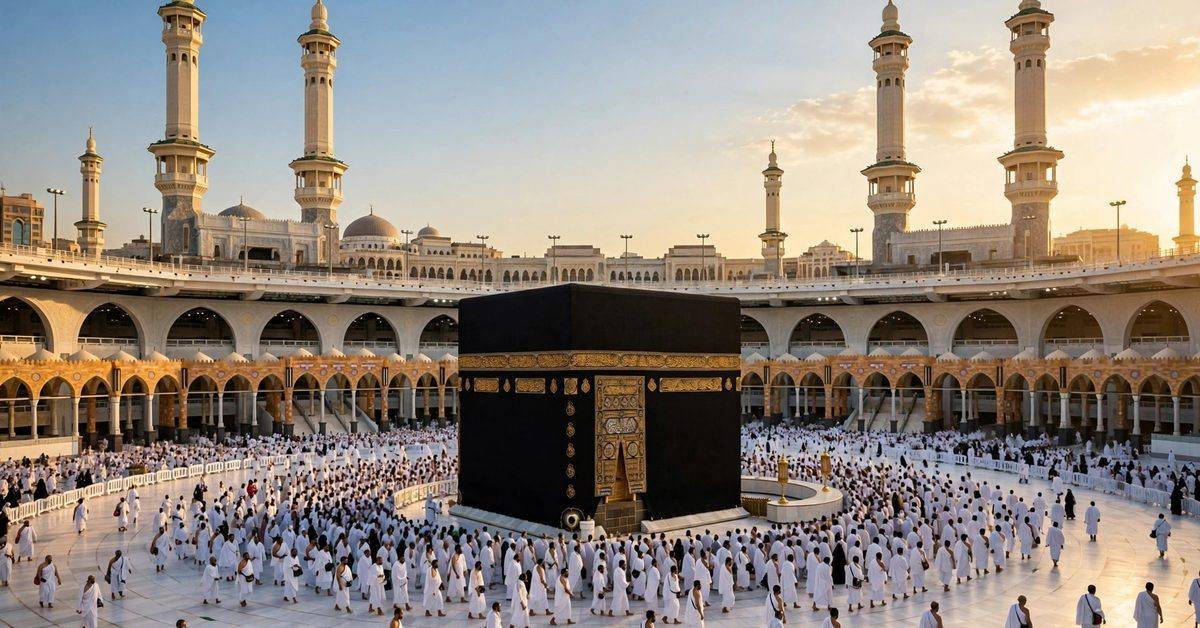
    In Masjid al-Haram, begin Tawaf at the Black Stone. Face it, raise your hands and say “Bismillah, Allahu Akbar” — touching or kissing it if you can reach it without pushing, or pointing towards it from a distance. Then walk anticlockwise around the Kaaba, keeping it on your left, for seven circuits — briskly in the first three, for men.

    The Prophet ﷺ said: “Tawaf around the House is like prayer, except that you may speak during it. So whoever speaks during it, let him not speak of anything but what is good.” (Jamiʿ at-Tirmidhi 960 — graded sahih by al-Albani)

    No dua is fixed for Tawaf — recite Quran, make dua, and remember Allah as you walk. Between the Yemeni Corner and the Black Stone, recite this dua from the Quran:

    رَبَّنَا آتِنَا فِي الدُّنْيَا حَسَنَةً وَفِي الْآخِرَةِ حَسَنَةً وَقِنَا عَذَابَ النَّارِ

    “Rabbanā ātinā fid-dunyā ḥasanah, wa fil-ākhirati ḥasanah, wa qinā ʿadhāban-nār.”

    “Our Lord, give us in this world [that which is] good and in the Hereafter [that which is] good and protect us from the punishment of the Fire.” (Surah Al-Baqarah 2:201)

    After the seventh circuit, pray two rak’ahs behind Maqam Ibrahim if possible, then drink Zamzam and make dua.

    Step 3: Sa’i — Walking Between Safa and Marwah

    At Safa, begin Sa’i. Allah says:

    إِنَّ الصَّفَا وَالْمَرْوَةَ مِن شَعَائِرِ اللَّهِ

    “Innaṣ-ṣafā wal-marwata min shaʿāʾirillāh.”

    “Indeed, as-Safa and al-Marwah are among the symbols of Allah.” (Surah Al-Baqarah 2:158)

    On Safa, face the Kaaba, say “Allahu Akbar” three times, then make dua. Walk to Marwah — one length. Men jog lightly between the two green lights. Repeat for seven lengths, finishing at Marwah. No dua is fixed for Sa’i either — pour your heart out to Allah. Sa’i remembers Hajar’s search for water for her son Ismail, a reminder that Allah never abandons those who trust Him.

    Step 4: Shave or Trim Your Hair — Umrah Complete

    After Sa’i, men shave their heads (the more rewarding option) or trim their hair evenly. Women cut a fingertip’s length from the ends of their hair. With this, you exit Ihram — your Umrah is complete.

    3 Common Mistakes First-Timers Make

    1. Treating Tawaf like a race. Pushing to kiss the Black Stone harms others — pointing from a distance is enough.

    2. Reciting duas from a book without understanding. Your own heartfelt dua beats words you do not understand.

    3. Forgetting the intention at the Miqat. Entering Makkah without Ihram means a penalty, so intend before crossing the boundary.

    Do Tawaf at quieter times — late at night or after Fajr. Wear broken-in sandals, carry water, and agree on a meeting point with your group. Keep your duas written down. The rites take two to three hours, so rest between them — patience during Umrah is itself worship.

    A short journey with an enormous return — sins forgiven, duas answered, a heart renewed. May Allah accept it and invite you again and again.

    FAQs

    How long does Umrah take?

    About two to three hours, depending on crowds — most pilgrims spend several days in Makkah for extra worship.

    Can I perform Umrah at any time of the year?

    Yes, unlike Hajj, which is fixed to specific days of Dhul-Hijjah — avoid the Hajj days themselves.

    Do women need a mahram for Umrah?

    Rules depend on your country and current Saudi visa policy — check the latest requirements before booking.

    What is the difference between Hajj and Umrah?

    Hajj is obligatory once in a lifetime for those who can afford it, performed only in Dhul-Hijjah with extra rites at Mina, Arafat and Muzdalifah; Umrah is a shorter, voluntary pilgrimage any time of the year.

    Can children perform Umrah?

    Yes — the reward is recorded for them, and the parents also receive reward for taking them.

    If you would like a caring teacher to help you or your child read the Quran fluently with Tajweed, book a free trial class with Noor Academy Pakistan today.

  • The Six Articles of Faith (Iman) in Islam Explained

    The Six Articles of Faith (Iman) in Islam Explained

    What do Muslims actually believe? The answer fits in six points. The six articles of faith — known in Arabic as Arkan al-Iman — are the core beliefs that define a Muslim’s faith: belief in Allah, His angels, His books, His messengers, the Last Day, and divine decree. Everything else in Islam, from prayer to fasting to good character, is built on this foundation.

    What Are the Six Articles of Faith?

    The six articles come from one of the most famous hadiths in Islam, the Hadith of Jibril. The angel Jibril came to the Prophet Muhammad ﷺ in the form of a man and asked him, “Tell me about iman (faith).” The Prophet ﷺ replied:

    الْإِيمَانُ أَنْ تُؤْمِنَ بِاللَّهِ وَمَلَائِكَتِهِ وَكُتُبِهِ وَرُسُلِهِ وَالْيَوْمِ الْآخِرِ وَتُؤْمِنَ بِالْقَدَرِ خَيْرِهِ وَشَرِّهِ

    “Al-imanu an tu’mina billahi wa mala’ikatihi wa kutubihi wa rusulihi wal-yawmil-akhiri wa tu’mina bil-qadari khayrihi wa sharrih.”

    “Faith is to believe in Allah, His angels, His books, His messengers, the Last Day, and to believe in divine decree, both its good and its bad.” (Sahih Muslim 8)

    The Quran states the same foundation in a single verse:

    آمَنَ الرَّسُولُ بِمَا أُنزِلَ إِلَيْهِ مِن رَّبِّهِ وَالْمُؤْمِنُونَ ۚ كُلٌّ آمَنَ بِاللَّهِ وَمَلَائِكَتِهِ وَكُتُبِهِ وَرُسُلِهِ لَا نُفَرِّقُ بَيْنَ أَحَدٍ مِّن رُّسُلِهِ ۚ وَقَالُوا سَمِعْنَا وَأَطَعْنَا ۖ غُفْرَانَكَ رَبَّنَا وَإِلَيْكَ الْمَصِيرُ

    “Amanar-rasulu bima unzila ilayhi mir-rabbihi wal-mu’minun. Kullun amana billahi wa mala’ikatihi wa kutubihi wa rusulihi, la nufarriqu bayna ahadin mir-rusulih. Wa qalu sami’na wa ata’na, ghufranaka rabbana wa ilaykal-masir.”

    “The Messenger has believed in what was revealed to him from his Lord, and [so have] the believers. All of them have believed in Allah and His angels and His books and His messengers, [saying], ‘We make no distinction between any of His messengers.’ And they say, ‘We hear and we obey. [We seek] Your forgiveness, our Lord, and to You is the [final] destination.’” (Surah Al-Baqarah 2:285)

    Here is each article, explained simply.

    1. Belief in Allah

    This is the first and greatest article: Allah is One, with no partner, no equal and no son. He is the Creator and Sustainer of everything, and He alone deserves worship. Surah Al-Ikhlas sums it up in four short verses:

    قُلْ هُوَ اللَّهُ أَحَدٌ ۝ اللَّهُ الصَّمَدُ ۝ لَمْ يَلِدْ وَلَمْ يُولَدْ ۝ وَلَمْ يَكُن لَّهُ كُفُوًا أَحَدٌ

    “Qul huwallahu ahad. Allahus-samad. Lam yalid wa lam yulad. Wa lam yakul-lahu kufuwan ahad.”

    “Say: He is Allah, the One. Allah, the Eternal Refuge. He neither begets nor is born, nor is there to Him any equivalent.” (Surah Al-Ikhlas 112:1–4)

    2. Belief in the Angels

    Angels are honourable servants of Allah, created from light, who never disobey Him and carry out His commands exactly. The Prophet ﷺ said: “The angels were created from light.” (Sahih Muslim 2996)

    Among them are Jibril, who brought revelation to the prophets; Mika’il, entrusted with rain and provision; and the angels who record our deeds. We cannot see angels, but believing in them reminds us that we are never truly alone — our actions are witnessed, and help from Allah can arrive in ways we do not see.

    3. Belief in the Revealed Books

    Allah sent guidance to humanity through books revealed to His messengers: the Torah to Musa, the Zabur (Psalms) to Dawud, the Injil (Gospel) to ‘Isa, and finally the Quran to Muhammad ﷺ. Muslims believe in all of them as originally revealed, and believe the Quran is the final revelation, preserved word for word, for all people until the Last Day.

    Practically, this article is why the Quran sits at the centre of a Muslim’s life: it is guidance itself, to be read, understood and lived by.

    4. Belief in the Messengers

    Allah chose messengers from among people to teach humanity how to worship Him and live rightly. Muslims believe in all of them without distinction — Nuh, Ibrahim, Musa, ‘Isa, and Muhammad ﷺ, the final messenger — and love and respect every one of them. The Quran commands this even-handed belief: “We make no distinction between any of His messengers” (Surah Al-Baqarah 2:285).

    This article protects us from two mistakes: rejecting a true prophet, and raising any prophet above his station as a servant and messenger of Allah. Muhammad ﷺ is the seal of the prophets, and his Sunnah shows us how to put the Quran into practice.

    5. Belief in the Last Day

    A Muslim believes this life is not the end. After death comes resurrection, the reckoning, and then Paradise or Hellfire, by Allah’s perfect justice and mercy. Every deed, large or small, will be weighed.

    This belief changes how we live today. It gives patience in hardship — injustice here is not the final word — and urgency to good deeds, because the time to act is now. It also gives hope: no sincere repentance is ever wasted, and no good deed, even a smile, goes unrecorded.

    6. Belief in Divine Decree (Qadar)

    The final article is belief that everything happens by Allah’s knowledge, will and wisdom — the good and the difficult alike. Allah says:

    إِنَّا كُلَّ شَيْءٍ خَلَقْنَاهُ بِقَدَرٍ

    “Inna kulla shay’in khalaqnahu bi-qadar.”

    “Indeed, all things We created with predestination.” (Surah Al-Qamar 54:49)

    Qadar does not mean sitting back and doing nothing. We still choose, strive and plan — and we are accountable for our choices. It means that after we have done our best, we trust the outcome to Allah. This trust is what turns anxiety into calm: you do your part, and you leave the result to the One who knows what you do not.

    How the Six Articles of Faith Shape Daily Life

    These six beliefs are not abstract theology; they are a daily compass. Belief in Allah anchors worship. Belief in the angels reminds you that your deeds matter even when no one is watching. Belief in the books and messengers gives you a trustworthy guide instead of guesswork. Belief in the Last Day keeps your priorities straight. Belief in Qadar gives you peace after effort.

    A simple way to teach them at home: one article each evening with your children, with one example from daily life for each. By the end of the week, the whole family will know the foundation of the faith by heart.

    Frequently Asked Questions

    What is the difference between the six articles of faith and the five pillars of Islam?

    The six articles of faith (iman) are what a Muslim believes in the heart; the five pillars — Shahadah, salah, zakat, fasting in Ramadan and Hajj — are the actions built on that belief. Belief without action is incomplete, and action without belief is empty.

    Do Muslims have to believe in all the prophets, or only Muhammad ﷺ?

    All of them. Belief in every messenger Allah sent, without distinction, is itself one of the six articles (Surah Al-Baqarah 2:285).

    Does belief in Qadar mean everything is already decided, so effort does not matter?

    No. Allah knows and wills all things, but human beings still choose and act, and are accountable for their choices. Plan, work hard, then trust the outcome to Him.

    Why is belief in angels included when we cannot see them?

    Because faith includes the unseen. The Quran describes angels as real servants of Allah who carry out His commands, and the Hadith of Jibril lists them among the six articles.

    How can I teach the six articles of faith to my children?

    One article a day, in plain words, with a daily-life example — Allah hears our dua; angels record our good deeds; the Quran is our guidebook; the prophets show us the way; the Last Day means our deeds count forever; Qadar means we try our best and trust Allah with the result.

    Start Today

    If you are new to Islam, or teaching it to your family, start here: learn these six articles by heart, and then learn what each one asks of you in daily life. Faith grows the same way a tree grows — from roots, quietly, day by day.

    If you would like your children to learn the foundations of faith alongside the Quran itself, book a free trial class with Noor Academy Pakistan — our qualified teachers teach Quran, Tajweed and Islamic basics online, at a time that suits your family, In sha Allah.

  • Dua for Anxiety: 5 Powerful Duas to Calm Your Heart

    Dua for Anxiety: 5 Powerful Duas to Calm Your Heart

    Anxiety is not a sign of weak faith. It is a human feeling — and Islam gives us words for it. Here are five authentic duas for anxiety from the Quran and Sunnah, with Arabic text, transliteration and translation, plus a simple daily routine to build them into your life.

    Why the Heart Feels Restless

    Worry about money, health, children, work or the future can sit in the chest all day and follow us into the night. Allah describes the cure in one verse:

    الَّذِينَ آمَنُوا وَتَطْمَئِنُّ قُلُوبُهُم بِذِكْرِ اللَّهِ ۗ أَلَا بِذِكْرِ اللَّهِ تَطْمَئِنُّ الْقُلُوبُ

    “Alladhīna āmanū wa taṭma’innu qulūbuhum bi-dhikrillāh. Alā bi-dhikrillāhi taṭma’innul-qulūb.”

    “Those who have believed and whose hearts are assured by the remembrance of Allah. Unquestionably, by the remembrance of Allah hearts are assured.” (Surah Ar-Ra’d 13:28)

    Dhikr — Quran recitation, prayer and dua — is that remembrance in practice.

    1. The Main Dua for Anxiety

    This is the dua the Prophet ﷺ taught to a companion weighed down by worries and debts. Abu Sa’id al-Khudri (may Allah be pleased with him) narrated that the Prophet ﷺ found Abu Umamah sitting in the mosque outside prayer time. When Abu Umamah said, “Never-ending worries and debts, O Messenger of Allah,” the Prophet ﷺ taught him these words and told him to say them morning and evening. Abu Umamah later said: “Then I did that, and Allah removed my worries and settled my debts.”

    اللَّهُمَّ إِنِّي أَعُوذُ بِكَ مِنَ الْهَمِّ وَالْحَزَنِ، وَالْعَجْزِ وَالْكَسَلِ، وَالْبُخْلِ وَالْجُبْنِ، وَضَلَعِ الدَّيْنِ، وَغَلَبَةِ الرِّجَالِ

    “Allāhumma innī a’ūdhu bika minal-hammi wal-ḥazan, wal-‘ajzi wal-kasal, wal-bukhli wal-jubn, wa ḍala’id-dayn, wa ghalabatir-rijāl.”

    “O Allah, I seek refuge in You from anxiety and grief, from incapacity and laziness, from miserliness and cowardice, from the burden of debt and from being overpowered by others.” (Sunan Abi Dawud, Hadith 1555; also in Sahih al-Bukhari, Hadith 6363)

    It covers both the feeling and its causes: helplessness, debt and pressure from others. Say it morning and evening, slowly.

    2. The Dua for Times of Distress

    When anxiety spikes suddenly — bad news, a frightening moment, a problem with no clear answer — the Prophet ﷺ had a shorter dua for exactly that moment. Ibn Abbas (may Allah be pleased with him) narrated that the Prophet ﷺ used to invoke Allah at times of distress, saying:

    لَا إِلَهَ إِلَّا اللَّهُ الْعَظِيمُ الْحَلِيمُ، لَا إِلَهَ إِلَّا اللَّهُ رَبُّ السَّمَوَاتِ وَالْأَرْضِ، وَرَبُّ الْعَرْشِ الْعَظِيمِ

    “Lā ilāha illallāhul-‘Aẓīmul-Ḥalīm, lā ilāha illallāhu Rabbus-samāwāti wal-arḍ, wa Rabbul-‘Arshil-‘Aẓīm.”

    “There is no deity worthy of worship except Allah, the Most Great, the Most Forbearing. There is no deity worthy of worship except Allah, the Lord of the heavens and the earth, and the Lord of the Magnificent Throne.” (Sahih al-Bukhari, Hadith 6345)

    This dua contains no request — only praise. In panic, it turns the heart from the size of the problem to the greatness of Allah.

    3. The Dua of Yunus (Peace Be Upon Him)

    Prophet Yunus (peace be upon him) called out to Allah from inside the belly of the whale, in darkness upon darkness. His words are the shortest dua in this post:

    لَا إِلَهَ إِلَّا أَنْتَ سُبْحَانَكَ إِنِّي كُنْتُ مِنَ الظَّالِمِينَ

    “Lā ilāha illā anta subḥānaka innī kuntu minaẓ-ẓālimīn.”

    “There is no deity except You; exalted are You. Indeed, I have been of the wrongdoers.” (Surah Al-Anbiya 21:87)

    He affirmed Allah’s oneness and owned his own mistake — the dua for anxiety mixed with guilt or regret.

    4. “Allah Is Sufficient for Us”

    After a battle, when the believers were told that a great army was gathering against them, their answer was not panic but trust:

    حَسْبُنَا اللَّهُ وَنِعْمَ الْوَكِيلُ

    “Ḥasbunallāhu wa ni’mal-Wakīl.”

    “Allah is sufficient for us, and He is the best Disposer of affairs.” (Surah Aal-e-Imran 3:173)

    This is the dua for anxiety caused by other people. It does not mean stopping action — take the step you can, then hand the outcome to Allah.

    5. Make Your Own Dua, in Your Own Words

    After the duas above, speak to Allah in your own language about exactly what worries you. After prayer, sit for a minute and say, “O Allah, You know what worries me. Make it easy, guide me to the right step, and give my heart peace.” Then take the next practical step, and trust Allah with the rest.

    A Simple Daily Routine for Anxiety

    1. Morning: After Fajr, recite the main dua for anxiety (Dua 1) once, slowly.
    2. During the day: When worry spikes, repeat the dua of distress (Dua 2) or “Hasbunallahu wa ni’mal Wakeel” (Dua 4) until your breathing settles.
    3. Evening: Before sleeping, recite Dua 1 again, then speak your own dua in your own words.
    4. Every day: Recite even a small portion of the Quran with understanding — Quran recitation is the highest form of remembrance.

    Start small. One dua, morning and evening, done consistently, is better than ten duas memorized and forgotten.

    When Anxiety Does Not Go Away

    Duas help, but they are not the whole answer. Sleep, regular prayer, talking to a trusted person, and less endless scrolling all help. If anxiety is constant or severe, or stops you sleeping or working normally, speak to a doctor or qualified counsellor too. That is taking the means Allah provided — keep making dua alongside it, not instead of it.

    Frequently Asked Questions

    Which dua is best for anxiety?

    “Allahumma inni a’udhu bika minal-hammi wal-hazan…” (Sunan Abi Dawud 1555) is the most direct dua for anxiety. Pair it with the dua of distress (Sahih al-Bukhari 6345) for sudden worry.

    How many times should I recite the dua for anxiety?

    Say the main dua morning and evening. The others have no fixed number — recite them slowly, with understanding.

    Can I make dua for anxiety in English or Urdu?

    Yes. Memorized duas are in Arabic, but your own dua can be in any language.

    Does anxiety mean my faith is weak?

    No. Prophets and companions felt grief and worry too. Turning to Allah when it comes is itself an act of faith.

    Can children recite these duas?

    Yes. Teach the short ones first — “Hasbunallahu wa ni’mal Wakeel” and the dua of Yunus — with their meanings.

    Should I stop other treatment if I make these duas?

    No. Dua and practical help go together — continue any support you need.

    Start Tonight

    Memorize one dua from this post today, say it morning and evening, and let the remembrance of Allah give your heart rest, in sha Allah.

    Want your family to learn the Quran with understanding? Book a free trial class at Noor Academy Pakistan — learn from certified tutors, one-on-one, from the comfort of your home.

  • 10 Benefits of Reciting the Quran Daily (With Proof)

    10 Benefits of Reciting the Quran Daily (With Proof)

    10 Benefits of Reciting the Quran Daily (With Proof)

    Reciting the Quran daily is one of the most rewarding habits a Muslim can build. These are ten authentic benefits of reciting the Quran daily, each backed by a verse of the Quran or a sahih hadith.

    1. The Quran Will Intercede for You on the Day of Judgment

    On that Day, the Quran itself will stand up and plead for its reciter:

    اقْرَءُوا الْقُرْآنَ فَإِنَّهُ يَأْتِي يَوْمَ الْقِيَامَةِ شَفِيعًا لِأَصْحَابِهِ

    “Iqra’ū al-Qur’ān fa-innahu ya’tī yawma al-qiyāmati shafī’an li-aṣḥābihi.”

    “Read the Quran, for it will come as an intercessor for its companions on the Day of Resurrection.” (Sahih Muslim, Hadith 804)

    Intercession is promised to the Quran’s daily companions.

    2. Every Letter Earns You Ten Rewards

    Few promises in our religion match this:

    مَنْ قَرَأَ حَرْفًا مِنْ كِتَابِ اللهِ فَلَهُ بِهِ حَسَنَةٌ، وَالْحَسَنَةُ بِعَشْرِ أَمْثَالِهَا، لَا أَقُولُ الم حَرْفٌ، وَلَكِنْ أَلِفٌ حَرْفٌ وَلَامٌ حَرْفٌ وَمِيمٌ حَرْفٌ

    “Man qara’a ḥarfan min kitāb Allāh fa lahu bihi ḥasanah, wal-ḥasanatu bi-‘ashri amthālihā. Lā aqūlu: Alif-Lām-Mīm ḥarf, wa lākin alif ḥarf, wa lām ḥarf, wa mīm ḥarf.”

    “Whoever reads a letter from the Book of Allah will have a good deed recorded for it, and each good deed is multiplied tenfold.” (Sunan al-Tirmidhi, Hadith 2910, graded hasan)

    Reading Surah Al-Fatihah alone earns over a thousand rewards in minutes.

    3. Tranquillity Descends Upon the Reciter

    The Prophet ﷺ promised this calm:

    مَا اجْتَمَعَ قَوْمٌ فِي بَيْتٍ مِنْ بُيُوتِ اللَّهِ يَتْلُونَ كِتَابَ اللَّهِ وَيَتَدَارَسُونَهُ بَيْنَهُمْ إِلَّا نَزَلَتْ عَلَيْهِمُ السَّكِينَةُ وَغَشِيَتْهُمُ الرَّحْمَةُ وَحَفَّتْهُمُ الْمَلَائِكَةُ وَذَكَرَهُمُ اللَّهُ فِيمَنْ عِنْدَهُ

    “Mā ijtama’a qawmun fī baytin min buyūt Allāh yatlūna kitāb Allāh wa yatadārasūnahu baynahum illā nazalat ‘alayhimu as-sakīnah wa ghashiyathumu ar-raḥmah wa ḥaffathumu al-malā’ikah wa dhakarahumu Allāhu fīman ‘indah.”

    “Any group that gathers in a house of Allah to recite the Book of Allah — tranquillity descends upon them, mercy covers them, the angels surround them, and Allah mentions them to those near Him.” (Sahih Muslim, Hadith 2699)

    4. Allah Remembers Those Who Remember Him

    Reciting the Quran is remembrance at its highest — and it is never unanswered:

    فَاذْكُرُونِي أَذْكُرْكُمْ وَاشْكُرُوا لِي وَلَا تَكْفُرُونِ

    “Fadhkurūnī adhkurkum wa-shkurū lī wa lā takfurūn.”

    “So remember Me; I will remember you. Be grateful to Me and do not deny Me.” (Surah Al-Baqarah 2:152)

    5. It Heals the Heart

    The Quran cures the illnesses of the heart — doubt, anxiety, grief:

    وَنُنَزِّلُ مِنَ الْقُرْآنِ مَا هُوَ شِفَاءٌ وَرَحْمَةٌ لِّلْمُؤْمِنِينَ

    “Wa nunazzilu mina al-Qur’ān mā huwa shifā’un wa raḥmatun lil-mu’minīn.”

    “And We send down of the Quran that which is healing and mercy for the believers.” (Surah Al-Isra 17:82)

    6. A Trade That Never Loses

    Allah calls the reciter’s habit the safest investment:

    إِنَّ الَّذِينَ يَتْلُونَ كِتَابَ اللَّهِ وَأَقَامُوا الصَّلَاةَ وَأَنفَقُوا مِمَّا رَزَقْنَاهُمْ سِرًّا وَعَلَانِيَةً يَرْجُونَ تِجَارَةً لَّن تَبُورَ

    “Inna alladhīna yatlūna kitāb Allāh wa aqāmū aṣ-ṣalāh wa anfaqū mimmā razaqnāhum sirran wa ‘alāniyatan yarjūna tijāratan lan tabūr.”

    “Indeed, those who recite the Book of Allah, establish prayer, and spend from what We provided them can expect a transaction that will never perish.” (Surah Al-Fatir 35:29)

    7. Your Rank in Paradise Rises With Every Verse

    Your recitation determines your rank in Paradise:

    يُقَالُ لِصَاحِبِ الْقُرْآنِ: اقْرَأْ وَارْتَقِ وَرَتِّلْ كَمَا كُنْتَ تُرَتِّلُ فِي الدُّنْيَا، فَإِنَّ مَنْزِلَتَكَ عِنْدَ آخِرِ آيَةٍ تَقْرَأُ بِهَا

    “Yuqālu li-ṣāḥib al-Qur’ān: iqra’ wa-rtaqi wa rattil kamā kunta turattilu fi ad-dunyā, fa-inna manzilataka ‘inda ākhiri āyatin taqra’u bihā.”

    “It will be said to the companion of the Quran: ‘Recite and ascend, reciting as you recited in the world, for your rank will be at the last verse you recite.’” (Sunan Abu Dawood, Hadith 1464; Sunan al-Tirmidhi, Hadith 2914)

    8. You Join the Best of People

    Daily recitation puts you among the best of believers:

    خَيْرُكُمْ مَنْ تَعَلَّمَ الْقُرْآنَ وَعَلَّمَهُ

    “Khayrukum man ta’allama al-Qur’āna wa ‘allamah.”

    “The best of you are those who learn the Quran and teach it.” (Sahih al-Bukhari, Hadith 5027)

    And if you find recitation difficult, you earn a double reward — no level of struggle is a reason to stop. (Sahih Muslim, Hadith 798)

    9. A Daily Companion That Guards You From Neglect

    The Messenger ﷺ will complain on Judgment Day about those who abandoned the Quran:

    وَقَالَ الرَّسُولُ يَا رَبِّ إِنَّ قَوْمِي اتَّخَذُوا هَٰذَا الْقُرْآنَ مَهْجُورًا

    “Wa qāla ar-rasūlu yā rabbi inna qawmī ittakhhadhū hādhā al-Qur’āna mahjūrā.”

    “And the Messenger will say: My Lord, my people took this Quran as something abandoned.” (Surah Al-Furqan 25:40)

    A page a day is your daily proof you did not abandon it.

    10. Small and Consistent Is the Most Beloved Deed

    You need a habit, not an hour:

    أَحَبُّ الأَعْمَالِ إِلَى اللَّهِ أَدْوَمُهَا وَإِنْ قَلَّ

    “Aḥabbul-a’māli ilā Allāhi adwamuhā wa in qalla.”

    “The most beloved deeds to Allah are those done most consistently, even if they are small.” (Sahih al-Bukhari, Hadith 646)

    5 Tips to Start Your Daily Recitation Habit

    1. Fix a time. Ten minutes after Fajr beats an hour you never find.
    2. Start small. One page a day completes the Quran in about 20 months.
    3. Use one mushaf. Familiar layouts strengthen fluency and memory.
    4. Read the meaning. One short translation note a day builds understanding.
    5. Get corrected. A qualified teacher fixes errors you cannot hear yourself. Join our online Quran classes to learn recitation with proper Tajweed.

    FAQs

    1. How much should I read daily to get these benefits?

    Even a few verses count. Start with half a page or one page daily and increase gradually.

    2. Is reading the translation enough?

    The promised rewards — letter-by-letter hasanat, intercession, and rank — are for reciting the Arabic text. Use a translation for understanding, with Arabic as the core habit.

    3. What is the best time to recite the Quran?

    After Fajr is the most blessed time:

    إِنَّ قُرْآنَ الْفَجْرِ كَانَ مَشْهُودًا

    “Inna qur’āna al-fajri kāna mashhūdā.”

    “Indeed, the recitation of dawn is ever witnessed.” (Surah Al-Isra 17:78)

    Any fixed time you can keep is excellent.

    4. I stumble and read slowly. Should I still recite daily?

    Yes — you earn a double reward for the struggle (Sahih Muslim, Hadith 798). Consider learning Tajweed with a teacher to improve steadily.

    5. How do I improve my recitation?

    Learn Tajweed from a qualified teacher and have them listen regularly. Our teachers at Noor Academy Pakistan teach it step by step in one-to-one online classes.


    Want to recite the Quran correctly? Book a free trial class with Noor Academy Pakistan — one-to-one online lessons with qualified teachers, In sha Allah.

  • Iman-e-Mufassal: The Detailed Declaration of Faith — Arabic, Transliteration & Meaning

    Iman-e-Mufassal: The Detailed Declaration of Faith — Arabic, Transliteration & Meaning

    Every Muslim child learns two short declarations of faith: Iman-e-Mujmal (the summary) and Iman-e-Mufassal (the detailed one). While Iman-e-Mujmal states belief in Allah in a few words, Iman-e-Mufassal spells out exactly what a Muslim believes — the seven articles of Iman that every believer should know by heart.

    If you are a parent, teaching Iman-e-Mufassal to your child is one of the simplest gifts of tarbiyah you can give. Here is the complete text with transliteration and meaning, explained simply.

    Iman-e-Mufassal in Arabic

    آمَنْتُ بِاللَّهِ وَمَلَائِكَتِهِ وَكُتُبِهِ وَرُسُلِهِ وَالْيَوْمِ الْآخِرِ وَالْقَدَرِ خَيْرِهِ وَشَرِّهِ مِنَ اللَّهِ تَعَالَىٰ وَالْبَعْثِ بَعْدَ الْمَوْتِ

    Transliteration

    Aamantu billaahi wa malaa’ikatihi wa kutubihi wa rusulihi wal yawmil aakhiri wal qadri khairihi wa sharrihi minallaahi ta’aala wal ba’thi ba’dal mawt.

    English Meaning

    “I believe in Allah, His angels, His Books, His Messengers, the Last Day, and that all good and evil is decreed by Allah the Exalted — and in resurrection after death.”

    The Seven Articles of Iman, Explained Simply

    Iman-e-Mufassal names seven articles of faith. Here is what each one means, in words a child can understand:

    1. Belief in Allah (آمَنْتُ بِاللَّهِ)
    Allah is One, with no partner. He created everything, He alone deserves worship, and nothing is like Him.

    2. Belief in His Angels (وَمَلَائِكَتِهِ)
    Angels are Allah’s obedient servants, created from light. They never disobey Him — Jibreel (AS) brought revelation, Mika’eel (AS) is entrusted with rain and provision, and the Kiraman Katibin record our deeds.

    3. Belief in His Books (وَكُتُبِهِ)
    Allah sent divine books to guide mankind — including the Tawrat (Torah), the Zabur (Psalms), the Injeel (Gospel), and finally the Quran, which is preserved exactly as revealed and is the final guidance for all of humanity.

    4. Belief in His Messengers (وَرُسُلِهِ)
    Allah sent prophets and messengers to every nation, from Adam (AS) to Muhammad ﷺ, the final Messenger. We love and honour all of them, and we follow the teachings of Prophet Muhammad ﷺ.

    5. Belief in the Last Day (وَالْيَوْمِ الْآخِرِ)
    This world will end, and every person will stand before Allah for judgment. Good deeds will be rewarded with Paradise, and evil will be punished — so every day is a chance to do good.

    6. Belief in Divine Decree — Qadr (وَالْقَدَرِ خَيْرِهِ وَشَرِّهِ مِنَ اللَّهِ تَعَالَى)
    Everything that happens — good or difficult — happens by Allah’s knowledge and decree. This belief gives a believer patience in hardship and gratitude in ease.

    7. Belief in Resurrection After Death (وَالْبَعْثِ بَعْدَ الْمَوْتِ)
    After death, Allah will raise us again for the Day of Judgment. This is why a Muslim lives with purpose: this life is a test, and the Hereafter is the real home.

    Why Every Child Should Learn Iman-e-Mufassal

    The seven articles of Iman are the foundation of a Muslim’s identity. When a child can say what they believe — and understand it — their faith has roots. A child who knows that angels record their deeds thinks twice before misbehaving; a child who believes in Qadr learns patience when things go wrong; a child who believes in the Last Day understands why honesty and kindness matter.

    This is also why Iman-e-Mufassal is traditionally taught right after Iman-e-Mujmal and before the Six Kalimas in children’s Islamic education.

    How to Help Your Child Memorize It

    1. Start with the meaning first. When a child understands the seven articles, the Arabic becomes much easier to memorize.
    2. Break it into parts. Learn it phrase by phrase — one article of faith per day, repeating together after Fajr or before bed.
    3. Recite it daily for a week. Repetition with understanding locks it in. Ask your child to explain each article in their own words.
    4. Learn it with a teacher. In our one-to-one classes, tutors teach Iman-e-Mufassal, the Kalimas and daily duas with correct pronunciation and revision — book a free trial class and see how quickly your child learns with personal attention.

    Frequently Asked Questions

    What is the difference between Iman-e-Mujmal and Iman-e-Mufassal?
    Iman-e-Mujmal is the summarized declaration (“I believe in Allah as He is, with all His names and attributes”), while Iman-e-Mufassal is the detailed declaration naming all seven articles of faith.

    What are the 7 articles of Iman in Iman-e-Mufassal?
    Belief in (1) Allah, (2) His angels, (3) His books, (4) His messengers, (5) the Last Day, (6) divine decree (Qadr), and (7) resurrection after death.

    Is Iman-e-Mufassal from the Quran or Hadith?
    Its articles are all established in the Quran and authentic hadith — most famously the Hadith of Jibreel (Sahih Muslim), where the Prophet ﷺ listed the six articles of Iman. The worded form memorized by children is a classical summary taught across the Muslim world for centuries.

    At what age should a child learn Iman-e-Mufassal?
    As soon as a child can memorize short passages — usually around age 5–7, alongside the Kalimas and short surahs. Understanding grows with age, so revisiting its meaning yearly is ideal.

    Want your child to learn Iman-e-Mufassal, the Six Kalimas and the Quran with correct pronunciation? Book a free trial class at Noor Academy Pakistan — one-to-one live classes with qualified male and female teachers, for Muslims and their families all over the world.

  • How to Pray Salah Correctly: A Step-by-Step Guide

    How to Pray Salah Correctly: A Step-by-Step Guide

    Salah is the five daily prayers facing the Kaaba: after wudu, stand, recite Al-Fatiha, bow, prostrate, sit for the tashahhud and finish with the salam. This guide shows you how to pray Salah exactly as the Prophet, peace be upon him, taught it.

    1. What Is Salah and Why It Matters

    Salah is the second pillar of Islam and the most important act of worship. Allah decreed the five daily prayers at fixed times (Surah An-Nisa 4:103), and He says prayer “prohibits immorality and wrongdoing” (Surah Al-Ankabut 29:45). It is also the first deed questioned on the Day of Judgment (Sunan al-Tirmidhi, Hadith 413).

    The Prophet, peace be upon him, said: “Pray as you have seen me praying” (Sahih al-Bukhari, Hadith 631) — and every detail below follows his practice.

    2. Before You Begin: The Essentials

    Four conditions must be in place before you pray:

    1. Purification — have wudu (or ghusl if required), as Allah commands in Surah Al-Ma’idah (5:6).
    2. Cleanliness — body, clothes and prayer place free of impurities.
    3. Covering — modest dress covering the body.
    4. The time — pray within each prayer’s fixed window (Surah An-Nisa 4:103), facing the Kaaba.

    3. The Five Daily Prayers and Their Rak’ahs

    One rak’ah is a full cycle of standing, bowing and prostrating. The obligatory (fard) rak’ahs are:

    • Fajr (dawn): 2 rak’ahs
    • Dhuhr (midday): 4 rak’ahs
    • Asr (afternoon): 4 rak’ahs
    • Maghrib (sunset): 3 rak’ahs
    • Isha (night): 4 rak’ahs

    The Prophet, peace be upon him, said the five daily prayers, and one Friday prayer to the next, expiate the sins committed between them — as long as major sins are avoided (Sahih Muslim, Hadith 233).

    4. How to Pray Salah: The Step-by-Step Method

    Follow this method for every prayer:

    Step 1: Intention. Stand facing the qiblah and make the intention (niyyah) in your heart for the prayer you are offering.

    Step 2: The opening takbir. Raise your hands to your shoulders or ears and say “Allahu Akbar” (Allah is the Greatest) — this takbirat al-ihram opens the prayer.

    Step 3: Standing recitation. Fold your right hand over your left in front of you, then recite Surah Al-Fatiha in every rak’ah — the Prophet, peace be upon him, said there is no prayer for the one who does not recite the Opening of the Book (Sahih al-Bukhari, Hadith 756). In the first two rak’ahs, follow it with another short surah or a few verses.

    Step 4: Ruku (bowing). Say “Allahu Akbar” and bow, hands on your knees, back level. Say “Subhana Rabbiyal Azeem” (Glory be to my Lord, the Most Great) three times, calmly.

    Step 5: Rising. Rise saying “Sami’ Allahu liman hamidah” (Allah hears the one who praises Him), then stand upright and say “Rabbana lakal hamd” (Our Lord, to You belongs all praise).

    Step 6: Sujud (prostration). Say “Allahu Akbar” and prostrate, then say “Subhana Rabbiyal A’la” (Glory be to my Lord, the Most High) three times. The Prophet, peace be upon him, said the servant is closest to his Lord while prostrating, so make much dua in sujud (Sahih Muslim, Hadith 482).

    Step 7: Sitting between sujuds. Rise saying “Allahu Akbar” and sit briefly, then prostrate a second time the same way.

    Step 8: Continue. Stand for the next rak’ah and repeat. After every two rak’ahs, sit for the tashahhud; in the last sitting add the durood on the Prophet, peace be upon him.

    Step 9: The salam. Turn your head right and say “As-salamu alaykum wa rahmatullah” (Peace and Allah’s mercy be upon you), then left the same way. Your prayer is complete.

    5. The Pillars That Make Salah Valid

    Every valid prayer contains these essentials: intention, standing (if able), the opening takbir, reciting Al-Fatiha, bowing, rising from it, prostration, sitting between the prostrations, calmness in each position, the final tashahhud and sitting for it, the two salams — all in order.

    Calmness matters most. The Prophet, peace be upon him, told a man who rushed his prayer three times: “Go back and pray, for you have not prayed” (Sahih al-Bukhari, Hadith 757) — then taught him to be still in every position. A rushed prayer is not a prayer.

    6. Common Mistakes to Avoid

    • Rushing through the movements — the single most common error; give each position its due.
    • Skipping wudu or praying before its time — both conditions above are non-negotiable.
    • Looking around during prayer — keep your gaze toward your place of prostration.
    • Excessive movement — it breaks the stillness prayer requires.
    • Not learning the meanings — understanding Al-Fatiha and the duas deepens the prayer.

    FAQs

    Do I need wudu to pray Salah? Yes — purification is a condition for prayer. Allah commands wudu before prayer in Surah Al-Ma’idah (5:6), and the Prophet, peace be upon him, said Allah does not accept prayer without purification (Sahih Muslim, Hadith 224).

    What if I have not memorized Al-Fatiha yet? Al-Fatiha is only seven short verses — a qualified teacher can have you reciting it correctly within days. Start today and keep learning until it is perfect.

    Can I pray in English instead of Arabic? The Quranic recitation in prayer is in Arabic, as revealed. Learn the meanings alongside the Arabic — understanding what you recite deepens every prayer.

    What should I do if I miss a prayer? Pray it as soon as you remember. The Prophet, peace be upon him, said: “Whoever forgets a prayer, let him pray it when he remembers” (Sahih al-Bukhari, Hadith 597).

    Do men and women pray the same way? The pillars and method are the same for men and women; minor posture differences vary by school — a teacher can show you.

    Learning to pray Salah correctly starts with one step: beginning. A qualified teacher can correct your recitation, posture and sequence far faster than reading alone. Noor Academy Pakistan offers one-to-one online Quran and Islamic classes for kids and adults — book a free trial class today.

  • The Five Pillars of Islam Explained Simply (With References)

    The Five Pillars of Islam Explained Simply (With References)

    The Five Pillars of Islam — Shahada, Salah, Zakat, Sawm and Hajj — are the five core practices every Muslim follows, explained simply here.

    The Five Pillars of Islam are the foundation of a Muslim’s faith and practice. The Prophet, peace be upon him, said that Islam is built upon five: testifying that there is no god but Allah and that Muhammad is His messenger, establishing prayer, giving Zakat, fasting in Ramadan, and performing Hajj (Bukhari 8, Muslim 16). Here is a simple, authentic explanation of each pillar.

    1. Shahada, the Declaration of Faith

    The Shahada is the testimony: Ash-hadu an la ilaha illa Allah, wa ash-hadu anna Muhammadan rasool Allah. I bear witness that there is no god but Allah, and I bear witness that Muhammad is the Messenger of Allah. Saying it with sincere belief is how a person enters Islam.

    2. Salah, the Five Daily Prayers

    Muslims pray five times a day: Fajr, Dhuhr, Asr, Maghrib, and Isha. Salah is the direct connection between the believer and Allah, and the Quran describes it as an obligation at fixed times (4:103).

    3. Zakat, Obligatory Charity

    Zakat is the annual charity of 2.5 percent of one’s qualifying savings, given to the poor and needy. The Quran names its recipients in detail (9:60), making charity a right of the poor, not just an act of generosity.

    4. Sawm, Fasting in Ramadan

    Every Ramadan, Muslims fast from dawn to sunset, abstaining from food, drink, and marital relations. Fasting was prescribed so that believers may attain taqwa, God-consciousness (Quran 2:183).

    5. Hajj, Pilgrimage to Makkah

    Hajj is the pilgrimage to Makkah, obligatory once in a lifetime for every Muslim who is physically and financially able. Millions gather each year in the largest annual act of worship in Islam.

    Why Are They Called Pillars?

    Just as pillars hold up a building, these five practices hold up the life of a Muslim. They are not the whole of Islam, but everything else in the faith rests upon them.

    Noor Academy Pakistan’s Islamic Studies courses teach children the Five Pillars one-to-one online, so book a free trial class.