
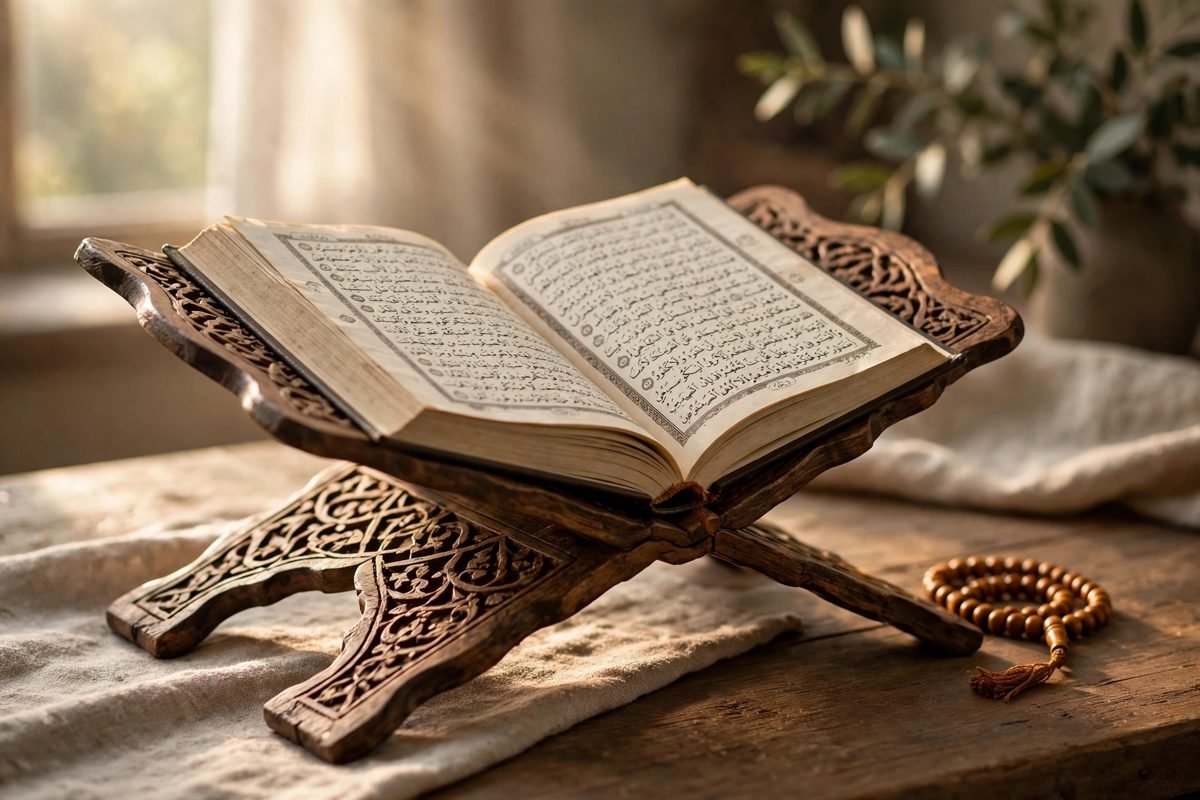
Category: Islamic Knowledge

  • Iman-e-Mufassal: The Detailed Declaration of Faith — Arabic, Transliteration & Meaning

    Iman-e-Mufassal: The Detailed Declaration of Faith — Arabic, Transliteration & Meaning

    Every Muslim child learns two short declarations of faith: Iman-e-Mujmal (the summary) and Iman-e-Mufassal (the detailed one). While Iman-e-Mujmal states belief in Allah in a few words, Iman-e-Mufassal spells out exactly what a Muslim believes — the seven articles of Iman that every believer should know by heart.

    If you are a parent, teaching Iman-e-Mufassal to your child is one of the simplest gifts of tarbiyah you can give. Here is the complete text with transliteration and meaning, explained simply.

    Iman-e-Mufassal in Arabic

    آمَنْتُ بِاللَّهِ وَمَلَائِكَتِهِ وَكُتُبِهِ وَرُسُلِهِ وَالْيَوْمِ الْآخِرِ وَالْقَدَرِ خَيْرِهِ وَشَرِّهِ مِنَ اللَّهِ تَعَالَىٰ وَالْبَعْثِ بَعْدَ الْمَوْتِ

    Transliteration

    Aamantu billaahi wa malaa’ikatihi wa kutubihi wa rusulihi wal yawmil aakhiri wal qadri khairihi wa sharrihi minallaahi ta’aala wal ba’thi ba’dal mawt.

    English Meaning

    “I believe in Allah, His angels, His Books, His Messengers, the Last Day, and that all good and evil is decreed by Allah the Exalted — and in resurrection after death.”

    The Seven Articles of Iman, Explained Simply

    Iman-e-Mufassal names seven articles of faith. Here is what each one means, in words a child can understand:

    1. Belief in Allah (آمَنْتُ بِاللَّهِ)
    Allah is One, with no partner. He created everything, He alone deserves worship, and nothing is like Him.

    2. Belief in His Angels (وَمَلَائِكَتِهِ)
    Angels are Allah’s obedient servants, created from light. They never disobey Him — Jibreel (AS) brought revelation, Mika’eel (AS) is entrusted with rain and provision, and the Kiraman Katibin record our deeds.

    3. Belief in His Books (وَكُتُبِهِ)
    Allah sent divine books to guide mankind — including the Tawrat (Torah), the Zabur (Psalms), the Injeel (Gospel), and finally the Quran, which is preserved exactly as revealed and is the final guidance for all of humanity.

    4. Belief in His Messengers (وَرُسُلِهِ)
    Allah sent prophets and messengers to every nation, from Adam (AS) to Muhammad ﷺ, the final Messenger. We love and honour all of them, and we follow the teachings of Prophet Muhammad ﷺ.

    5. Belief in the Last Day (وَالْيَوْمِ الْآخِرِ)
    This world will end, and every person will stand before Allah for judgment. Good deeds will be rewarded with Paradise, and evil will be punished — so every day is a chance to do good.

    6. Belief in Divine Decree — Qadr (وَالْقَدَرِ خَيْرِهِ وَشَرِّهِ مِنَ اللَّهِ تَعَالَى)
    Everything that happens — good or difficult — happens by Allah’s knowledge and decree. This belief gives a believer patience in hardship and gratitude in ease.

    7. Belief in Resurrection After Death (وَالْبَعْثِ بَعْدَ الْمَوْتِ)
    After death, Allah will raise us again for the Day of Judgment. This is why a Muslim lives with purpose: this life is a test, and the Hereafter is the real home.

    Why Every Child Should Learn Iman-e-Mufassal

    The seven articles of Iman are the foundation of a Muslim’s identity. When a child can say what they believe — and understand it — their faith has roots. A child who knows that angels record their deeds thinks twice before misbehaving; a child who believes in Qadr learns patience when things go wrong; a child who believes in the Last Day understands why honesty and kindness matter.

    This is also why Iman-e-Mufassal is traditionally taught right after Iman-e-Mujmal and before the Six Kalimas in children’s Islamic education.

    How to Help Your Child Memorize It

    1. Start with the meaning first. When a child understands the seven articles, the Arabic becomes much easier to memorize.
    2. Break it into parts. Learn it phrase by phrase — one article of faith per day, repeating together after Fajr or before bed.
    3. Recite it daily for a week. Repetition with understanding locks it in. Ask your child to explain each article in their own words.
    4. Learn it with a teacher. In our one-to-one classes, tutors teach Iman-e-Mufassal, the Kalimas and daily duas with correct pronunciation and revision — book a free trial class and see how quickly your child learns with personal attention.

    Frequently Asked Questions

    What is the difference between Iman-e-Mujmal and Iman-e-Mufassal?

    Iman-e-Mujmal is the summarized declaration (“I believe in Allah as He is, with all His names and attributes”), while Iman-e-Mufassal is the detailed declaration naming all seven articles of faith.

    What are the 7 articles of Iman in Iman-e-Mufassal?

    Belief in (1) Allah, (2) His angels, (3) His books, (4) His messengers, (5) the Last Day, (6) divine decree (Qadr), and (7) resurrection after death.

    Is Iman-e-Mufassal from the Quran or Hadith?

    Its articles are all established in the Quran and authentic hadith — most famously the Hadith of Jibreel (Sahih Muslim), where the Prophet listed the six articles of Iman. The worded form memorized by children is a classical summary taught across the Muslim world for centuries.

    At what age should a child learn Iman-e-Mufassal?

    As soon as a child can memorize short passages — usually around age 5–7, alongside the Kalimas and short surahs. Understanding grows with age, so revisiting its meaning yearly is ideal.

    Want your child to learn Iman-e-Mufassal, the Six Kalimas and the Quran with correct pronunciation? Book a free trial class at Noor Academy Pakistan, online Quran academy — one-to-one live classes with qualified male and female teachers, for Muslims and their families all over the world.
  • How to Pray Salah Correctly: A Step-by-Step Guide

    How to Pray Salah Correctly: A Step-by-Step Guide

    Salah is the five daily prayers facing the Kaaba: after wudu, stand, recite Al-Fatiha, bow, prostrate, sit for the tashahhud and finish with the salam. This guide shows you how to pray Salah exactly as the Prophet, peace be upon him, taught it.

    1. What Is Salah and Why It Matters

    Salah is the second pillar of Islam and the most important act of worship. Allah decreed the five daily prayers at fixed times (Surah An-Nisa 4:103), and He says prayer “prohibits immorality and wrongdoing” (Surah Al-Ankabut 29:45). It is also the first deed questioned on the Day of Judgment (Sunan al-Tirmidhi, Hadith 413).

    The Prophet, peace be upon him, said: “Pray as you have seen me praying” (Sahih al-Bukhari, Hadith 631) — and every detail below follows his practice.

    2. Before You Begin: The Essentials

    Four conditions must be in place before you pray:

    1. Purification — have wudu (or ghusl if required), as Allah commands in Surah Al-Ma’idah (5:6).
    2. Cleanliness — body, clothes and prayer place free of impurities.
    3. Covering — modest dress covering the body.
    4. The time — pray within each prayer’s fixed window (Surah An-Nisa 4:103), facing the Kaaba.

    3. The Five Daily Prayers and Their Rak’ahs

    One rak’ah is a full cycle of standing, bowing and prostrating. The obligatory (fard) rak’ahs are:

    • Fajr (dawn): 2 rak’ahs
    • Dhuhr (midday): 4 rak’ahs
    • Asr (afternoon): 4 rak’ahs
    • Maghrib (sunset): 3 rak’ahs
    • Isha (night): 4 rak’ahs

    The Prophet, peace be upon him, said the five daily prayers, and one Friday prayer to the next, expiate the sins committed between them — as long as major sins are avoided (Sahih Muslim, Hadith 233).

    4. How to Pray Salah: The Step-by-Step Method

    Follow this method for every prayer:

    Step 1: Intention. Stand facing the qiblah and make the intention (niyyah) in your heart for the prayer you are offering.

    Step 2: The opening takbir. Raise your hands to your shoulders or ears and say “Allahu Akbar” (Allah is the Greatest) — this takbirat al-ihram opens the prayer.

    Step 3: Standing recitation. Fold your right hand over your left in front of you, then recite Surah Al-Fatiha in every rak’ah — the Prophet, peace be upon him, said there is no prayer for the one who does not recite the Opening of the Book (Sahih al-Bukhari, Hadith 756). In the first two rak’ahs, follow it with another short surah or a few verses.

    Step 4: Ruku (bowing). Say “Allahu Akbar” and bow, hands on your knees, back level. Say “Subhana Rabbiyal Azeem” (Glory be to my Lord, the Most Great) three times, calmly.

    Step 5: Rising. Rise saying “Sami’ Allahu liman hamidah” (Allah hears the one who praises Him), then stand upright and say “Rabbana lakal hamd” (Our Lord, to You belongs all praise).

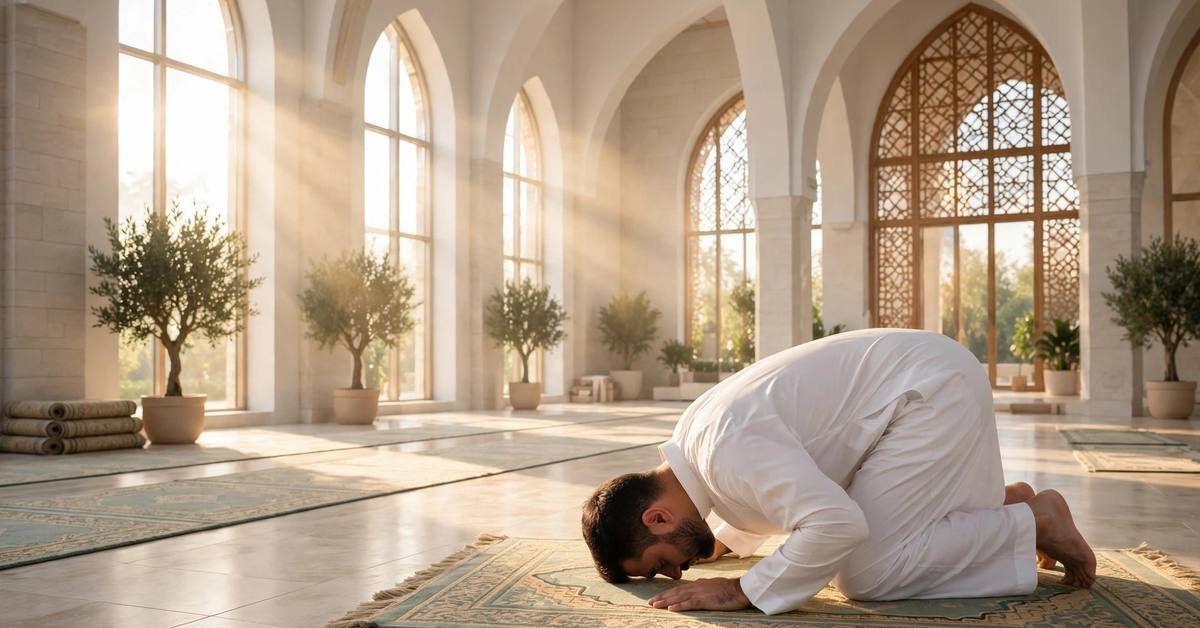
    Step 6: Sujud (prostration). Say “Allahu Akbar” and prostrate, then say “Subhana Rabbiyal A’la” (Glory be to my Lord, the Most High) three times. The Prophet, peace be upon him, said the servant is closest to his Lord while prostrating, so make much dua in sujud (Sahih Muslim, Hadith 482).

    Step 7: Sitting between sujuds. Rise saying “Allahu Akbar” and sit briefly, then prostrate a second time the same way.

    Step 8: Continue. Stand for the next rak’ah and repeat. After every two rak’ahs, sit for the tashahhud; in the last sitting add the durood on the Prophet, peace be upon him.

    Step 9: The salam. Turn your head right and say “As-salamu alaykum wa rahmatullah” (Peace and Allah’s mercy be upon you), then left the same way. Your prayer is complete.

    5. The Pillars That Make Salah Valid

    Every valid prayer contains these essentials: intention, standing (if able), the opening takbir, reciting Al-Fatiha, bowing, rising from it, prostration, sitting between the prostrations, calmness in each position, the final tashahhud and sitting for it, the two salams — all in order.

    Calmness matters most. The Prophet, peace be upon him, told a man who rushed his prayer three times: “Go back and pray, for you have not prayed” (Sahih al-Bukhari, Hadith 757) — then taught him to be still in every position. A rushed prayer is not a prayer.

    6. Common Mistakes to Avoid

    • Rushing through the movements — the single most common error; give each position its due.
    • Skipping wudu or praying before its time — both conditions above are non-negotiable.
    • Looking around during prayer — keep your gaze toward your place of prostration.
    • Excessive movement — it breaks the stillness prayer requires.
    • Not learning the meanings — understanding Al-Fatiha and the duas deepens the prayer.

    FAQs

    Do I need wudu to pray Salah? Yes — purification is a condition for prayer. Allah commands wudu before prayer in Surah Al-Ma’idah (5:6), and the Prophet, peace be upon him, said Allah does not accept prayer without purification (Sahih Muslim, Hadith 224).

    What if I have not memorized Al-Fatiha yet? Al-Fatiha is only seven short verses — a qualified teacher can have you reciting it correctly within days. Start today and keep learning until it is perfect.

    Can I pray in English instead of Arabic? The Quranic recitation in prayer is in Arabic, as revealed. Learn the meanings alongside the Arabic — understanding what you recite deepens every prayer.

    What should I do if I miss a prayer? Pray it as soon as you remember. The Prophet, peace be upon him, said: “Whoever forgets a prayer, let him pray it when he remembers” (Sahih al-Bukhari, Hadith 597).

    Do men and women pray the same way? The pillars and method are the same for men and women; minor posture differences vary by school — a teacher can show you.

    Learning to pray Salah correctly starts with one step: beginning. A qualified teacher can correct your recitation, posture and sequence far faster than reading alone. Noor Academy Pakistan offers one-to-one online Quran and Islamic classes for kids and adults — book a free trial class today.

  • The Five Pillars of Islam Explained Simply (With References)

    The Five Pillars of Islam Explained Simply (With References)

    The Five Pillars of Islam — Shahada, Salah, Zakat, Sawm and Hajj — are the five core practices every Muslim follows, explained simply here.

    The Five Pillars of Islam are the foundation of a Muslim’s faith and practice. The Prophet, peace be upon him, said that Islam is built upon five: testifying that there is no god but Allah and that Muhammad is His messenger, establishing prayer, giving Zakat, fasting in Ramadan, and performing Hajj (Sahih al-Bukhari 8, Sahih Muslim 16). Here is a simple, authentic explanation of each pillar.

    بُنِيَ الْإِسْلَامُ عَلَى خَمْسٍ

    “Buniyal-Islamu ‘ala khamsin.”

    “Islam is built upon five.” (Sahih al-Bukhari 8, Sahih Muslim 16)

    1. Shahada, the Declaration of Faith

    The Shahada is the testimony:

    أَشْهَدُ أَنْ لَا إِلَٰهَ إِلَّا ٱللَّٰهُ وَأَشْهَدُ أَنَّ مُحَمَّدًا رَسُولُ ٱللَّٰهِ

    “Ash-hadu an la ilaha illa Allah, wa ash-hadu anna Muhammadan rasool Allah.”

    “I bear witness that there is no god but Allah, and I bear witness that Muhammad is the Messenger of Allah.”

    Saying it with sincere belief is how a person enters Islam. It is also the first thing whispered into a newborn’s ear and the words a Muslim hopes to leave this world upon — the beginning and the end of a life of faith.

    2. Salah, the Five Daily Prayers

    Muslims pray five times a day: Fajr, Dhuhr, Asr, Maghrib, and Isha. Salah is the direct connection between the believer and Allah, and the Quran describes it as an obligation at fixed times:

    إِنَّ ٱلصَّلَوٰةَ كَانَتْ عَلَى ٱلْمُؤْمِنِينَ كِتَٰبًۭا مَّوْقُوتًۭا

    “Innas-salata kanat ‘alal-mu’minina kitaban mawquta.”

    “Indeed, prayer has been decreed upon the believers a decree of specified times.” (Quran 4:103)

    Prayer is not only worship — it is the structure of a Muslim’s day, five pauses that bring the heart back to Allah no matter how busy life becomes.

    3. Zakat, Obligatory Charity

    Zakat is the annual charity of 2.5 percent of one’s qualifying savings, given to the poor and needy. The Quran names its recipients in detail:

    إِنَّمَا ٱلصَّدَقَٰتُ لِلْفُقَرَآءِ وَٱلْمَسَٰكِينِ

    “Innamas-sadaqatu lil-fuqara’i wal-masakin.”

    “Zakat expenditures are only for the poor and for the needy…” (Quran 9:60)

    Zakat makes charity a right of the poor, not just an act of generosity — a pillar that keeps wealth circulating and the community caring for its weakest members.

    4. Sawm, Fasting in Ramadan

    Every Ramadan, Muslims fast from dawn to sunset, abstaining from food, drink, and marital relations. Fasting was prescribed so that believers may attain taqwa, God-consciousness:

    يَٰٓأَيُّهَا ٱلَّذِينَ ءَامَنُوا۟ كُتِبَ عَلَيْكُمُ ٱلصِّيَامُ كَمَا كُتِبَ عَلَى ٱلَّذِينَ مِن قَبْلِكُمْ لَعَلَّكُمْ تَتَّقُونَ

    “Ya ayyuhalladhina amanu kutiba ‘alaykumus-siyamu kama kutiba ‘alalladhina min qablikum la’allakum tattaqun.”

    “O you who have believed, decreed upon you is fasting as it was decreed upon those before you that you may become righteous.” (Quran 2:183)

    Fasting teaches patience, gratitude, and self-control — and it reminds the believer, every single day of Ramadan, what hunger feels like for those who have little.

    5. Hajj, Pilgrimage to Makkah

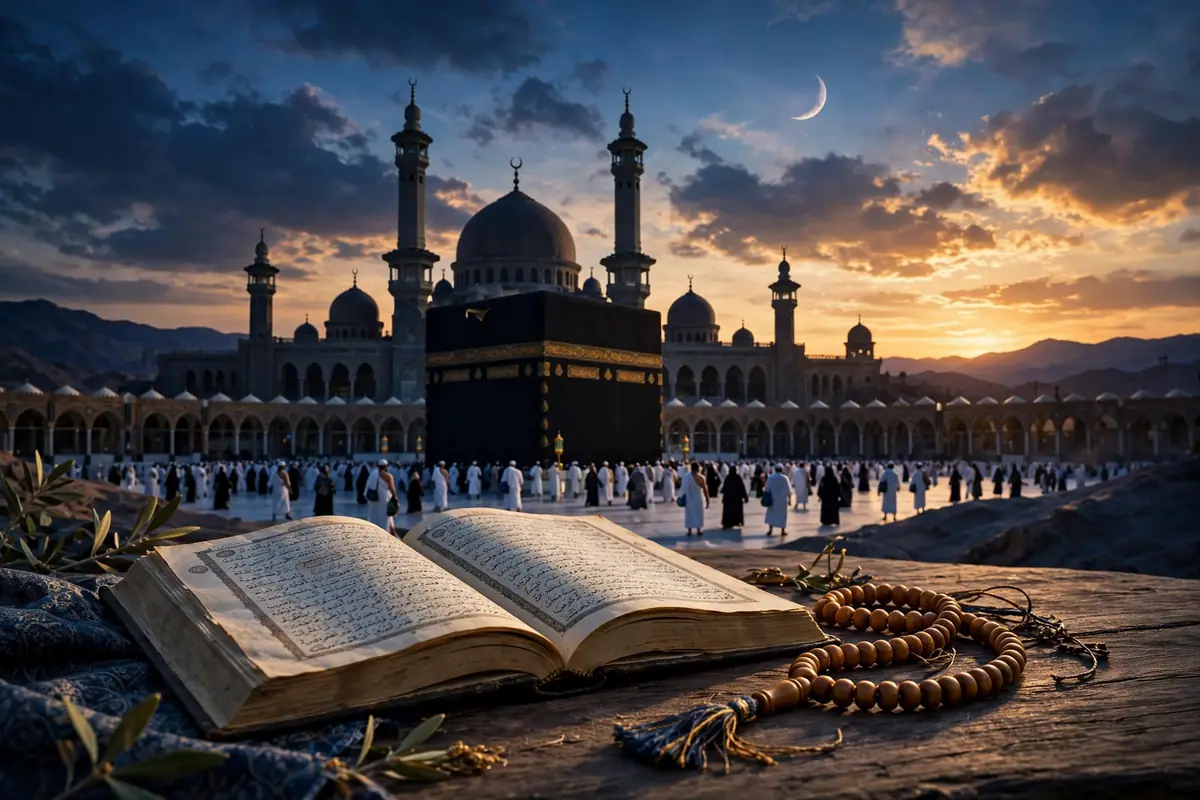
    Hajj is the pilgrimage to Makkah, obligatory once in a lifetime for every Muslim who is physically and financially able. Millions gather each year in the largest annual act of worship in Islam.

    وَلِلَّهِ عَلَى ٱلنَّاسِ حِجُّ ٱلْبَيْتِ مَنِ ٱسْتَطَاعَ إِلَيْهِ سَبِيلًۭا

    “Wa lillahi ‘alan-nasi hijjul-bayti manistata’a ilayhi sabila.”

    “And [due] to Allah from the people is a pilgrimage to the House — for whoever is able to find thereto a way.” (Quran 3:97)

    In Hajj, kings and workers stand side by side in the same simple white cloth — a living picture of the equality of all believers before Allah.

    Why Are They Called Pillars?

    Just as pillars hold up a building, these five practices hold up the life of a Muslim. They are not the whole of Islam, but everything else in the faith rests upon them.

    Noor Academy Pakistan’s Islamic Studies courses teach children the Five Pillars one-to-one online, so book a free trial class.

    How to Teach the Five Pillars to Your Children

    Children learn the pillars best by living them, a little at a time:

    1. Start with the Shahada. Teach your child the words early, and what they mean in simple language: only Allah deserves worship, and Muhammad ﷺ is His messenger.
    2. Pray where they can see you. Children copy what they see. Let them stand beside you for Salah, even if they only manage a few minutes at first. The Prophet ﷺ said: “Command your children to pray when they are seven years old.” (Sunan Abi Dawud 495)
    3. Make Zakat tangible. Give your child a small amount to hand to someone in need themselves — generosity learned by doing stays for life.
    4. Let them taste fasting. Young children can try a half-day fast in Ramadan, or fast until lunch, so the month feels like theirs too.
    5. Tell Hajj stories. Show them pictures of Makkah, tell them about the Kaaba, and let them dream of the journey — longing is the first step toward going.

    Frequently Asked Questions

    What are the Five Pillars of Islam?

    Shahada (the declaration of faith), Salah (the five daily prayers), Zakat (obligatory charity), Sawm (fasting in Ramadan), and Hajj (pilgrimage to Makkah). They are the five core practices every Muslim follows.

    Do children have to follow all five pillars?

    Children are not accountable until puberty, but they should be taught gradually — prayer from the age of seven, fasting in small steps, and charity by example — so the pillars feel natural by the time they become obligatory.

    At what age should children start praying?

    The Prophet ﷺ advised parents to command their children to pray at seven (Sunan Abi Dawud 495). Start gently, with short prayers beside you, and build the habit over time.

    Is Hajj obligatory for children?

    No. Hajj is obligatory only once in a lifetime for an adult Muslim who is physically and financially able. A child who performs Hajj is rewarded, but the obligation remains for adulthood.

    Where can my child learn the Five Pillars properly?

    Noor Academy Pakistan’s Islamic Studies courses teach children the Five Pillars one-to-one online, so book a free trial class.