
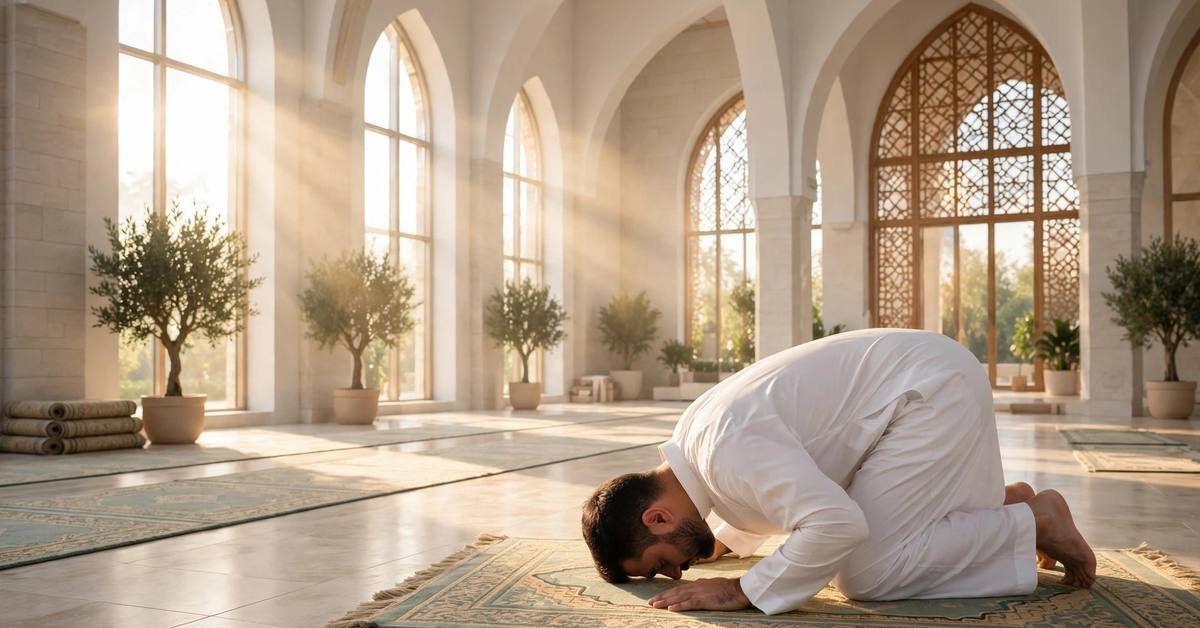
Salah is the five daily prayers facing the Kaaba: after wudu, stand, recite Al-Fatiha, bow, prostrate, sit for the tashahhud and finish with the salam. This guide shows you how to pray Salah exactly as the Prophet, peace be upon him, taught it.
1. What Is Salah and Why It Matters
Salah is the second pillar of Islam and the most important act of worship. Allah decreed the five daily prayers at fixed times (Surah An-Nisa 4:103), and He says prayer “prohibits immorality and wrongdoing” (Surah Al-Ankabut 29:45). It is also the first deed questioned on the Day of Judgment (Sunan al-Tirmidhi, Hadith 413).
The Prophet, peace be upon him, said: “Pray as you have seen me praying” (Sahih al-Bukhari, Hadith 631) — and every detail below follows his practice.
2. Before You Begin: The Essentials
Four conditions must be in place before you pray:
1. Purification — have wudu (or ghusl if required), as Allah commands in Surah Al-Ma’idah (5:6).
2. Cleanliness — body, clothes and prayer place free of impurities.
3. Covering — modest dress covering the body.
4. The time — pray within each prayer’s fixed window (Surah An-Nisa 4:103), facing the Kaaba.
3. The Five Daily Prayers and Their Rak’ahs
One rak’ah is a full cycle of standing, bowing and prostrating. The obligatory (fard) rak’ahs are:
• Fajr (dawn): 2 rak’ahs
• Dhuhr (midday): 4 rak’ahs
• Asr (afternoon): 4 rak’ahs
• Maghrib (sunset): 3 rak’ahs
• Isha (night): 4 rak’ahs
The Prophet, peace be upon him, said the five daily prayers, and one Friday prayer to the next, expiate the sins committed between them — as long as major sins are avoided (Sahih Muslim, Hadith 233).
4. How to Pray Salah: The Step-by-Step Method
Follow this method for every prayer:
Step 1: Intention. Stand facing the qiblah and make the intention (niyyah) in your heart for the prayer you are offering.
Step 2: The opening takbir. Raise your hands to your shoulders or ears and say “Allahu Akbar” (Allah is the Greatest) — this takbirat al-ihram opens the prayer.
Step 3: Standing recitation. Fold your right hand over your left in front of you, then recite Surah Al-Fatiha in every rak’ah — the Prophet, peace be upon him, said there is no prayer for the one who does not recite the Opening of the Book (Sahih al-Bukhari, Hadith 756). In the first two rak’ahs, follow it with another short surah or a few verses.
Step 4: Ruku (bowing). Say “Allahu Akbar” and bow, hands on your knees, back level. Say “Subhana Rabbiyal Azeem” (Glory be to my Lord, the Most Great) three times, calmly.
Step 5: Rising. Rise saying “Sami’ Allahu liman hamidah” (Allah hears the one who praises Him), then stand upright and say “Rabbana lakal hamd” (Our Lord, to You belongs all praise).
Step 6: Sujud (prostration). Say “Allahu Akbar” and prostrate, then say “Subhana Rabbiyal A’la” (Glory be to my Lord, the Most High) three times. The Prophet, peace be upon him, said the servant is closest to his Lord while prostrating, so make much dua in sujud (Sahih Muslim, Hadith 482).
Step 7: Sitting between sujuds. Rise saying “Allahu Akbar” and sit briefly, then prostrate a second time the same way.
Step 8: Continue. Stand for the next rak’ah and repeat. After every two rak’ahs, sit for the tashahhud; in the last sitting add the durood on the Prophet, peace be upon him.
Step 9: The salam. Turn your head right and say “As-salamu alaykum wa rahmatullah” (Peace and Allah’s mercy be upon you), then left the same way. Your prayer is complete.
5. The Pillars That Make Salah Valid
Every valid prayer contains these essentials: intention, standing (if able), the opening takbir, reciting Al-Fatiha, bowing, rising from it, prostration, sitting between the prostrations, calmness in each position, the final tashahhud and sitting for it, the two salams — all in order.
Calmness matters most. The Prophet, peace be upon him, told a man who rushed his prayer three times: “Go back and pray, for you have not prayed” (Sahih al-Bukhari, Hadith 757) — then taught him to be still in every position. A rushed prayer is not a prayer.
6. Common Mistakes to Avoid
• Rushing through the movements — the single most common error; give each position its due.
• Skipping wudu or praying before its time — both conditions above are non-negotiable.
• Looking around during prayer — keep your gaze toward your place of prostration.
• Excessive movement — it breaks the stillness prayer requires.
• Not learning the meanings — understanding Al-Fatiha and the duas deepens the prayer.
FAQs
Do I need wudu to pray Salah? Yes — purification is a condition for prayer. Allah commands wudu before prayer in Surah Al-Ma’idah (5:6), and the Prophet, peace be upon him, said Allah does not accept prayer without purification (Sahih Muslim, Hadith 224).
What if I have not memorized Al-Fatiha yet? Al-Fatiha is only seven short verses — a qualified teacher can have you reciting it correctly within days. Start today and keep learning until it is perfect.
Can I pray in English instead of Arabic? The Quranic recitation in prayer is in Arabic, as revealed. Learn the meanings alongside the Arabic — understanding what you recite deepens every prayer.
What should I do if I miss a prayer? Pray it as soon as you remember. The Prophet, peace be upon him, said: “Whoever forgets a prayer, let him pray it when he remembers” (Sahih al-Bukhari, Hadith 597).
Do men and women pray the same way? The pillars and method are the same for men and women; minor posture differences vary by school — a teacher can show you.
Learning to pray Salah correctly starts with one step: beginning. A qualified teacher can correct your recitation, posture and sequence far faster than reading alone. Noor Academy Pakistan offers one-to-one online Quran and Islamic classes for kids and adults — book a free trial class today.
Leave a Reply