
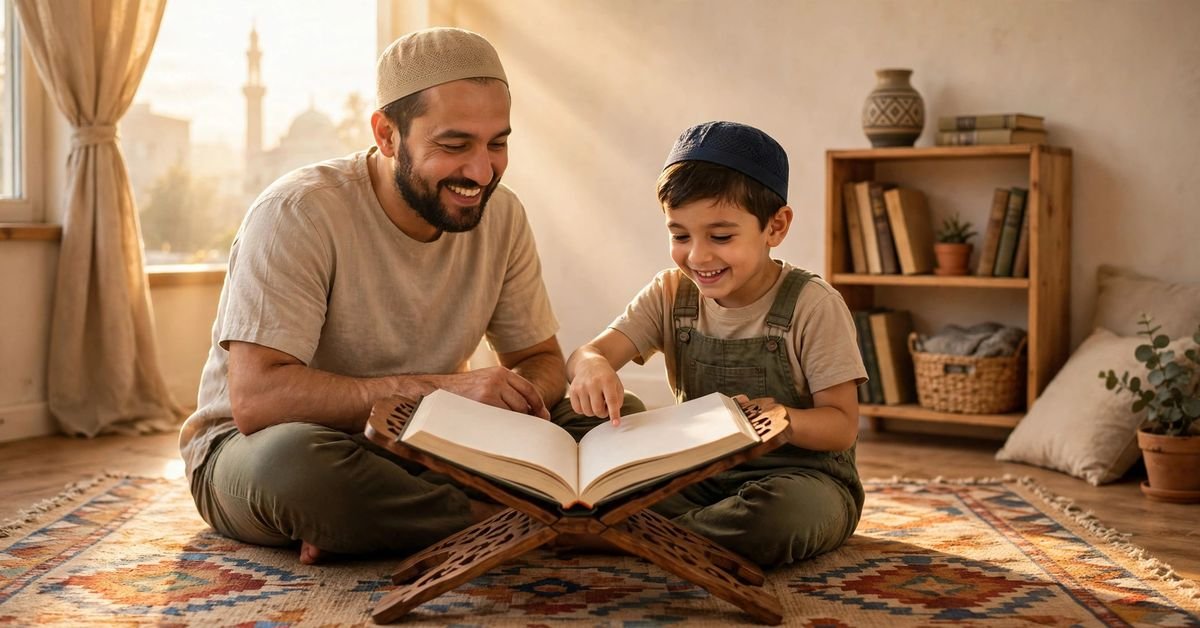
How to Teach Your Child Quran at Home: A Parent’s Guide
You can teach your child the Quran at home with three things: the right age to begin, a short daily routine they enjoy, and gentle consistency. Start with letter recognition and listening, keep sessions to 15–20 minutes, and use praise and repetition — not pressure — so the Quran becomes a source of love in your child’s heart.
1. Why Teaching the Quran at Home Is Your Duty — and Your Gift
Allah commands the believers:
يَا أَيُّهَا الَّذِينَ آمَنُوا قُوا أَنفُسَكُمْ وَأَهْلِيكُمْ نَارًا
“Yā ayyuhal-ladhīna āmanū qū anfusakum wa ahlīkum nārā.”
“O you who have believed, protect yourselves and your families from a Fire…” (Surah At-Tahrim 66:6)
Teaching your child the Quran is not an optional extra — it is part of protecting your family. And every letter they learn brings you reward too:
مَنْ قَرَأَ حَرْفًا مِنْ كِتَابِ اللَّهِ فَلَهُ بِهِ حَسَنَةٌ
“Man qara’a ḥarfan min kitāb Allāh fa lahu bihi ḥasanah.”
“Whoever reads a letter from the Book of Allah will have a good deed recorded for it.” (Sunan al-Tirmidhi, Hadith 2910, graded hasan sahih)
Imagine the reward of every letter your child recites — because you taught them. The Prophet, peace be upon him, also said every child is born upon the fitrah, the natural disposition toward goodness:
مَا مِنْ مَوْلُودٍ إِلَّا يُولَدُ عَلَى الْفِطْرَةِ
“Mā min mawlūdin illā yūladu ‘alal-fiṭrah.”
“No child is born except upon the fitrah.” (Sahih al-Bukhari, Hadith 1292; Sahih Muslim, Hadith 2658)
Your child is naturally drawn to truth — your job is simply to water that seed early, with love.
2. The Right Age to Start Teaching Your Child the Quran
There is no single “Quran age” fixed in the Qur’an or Sunnah, but the Prophetic pattern is clear: begin gently and early. The Prophet, peace be upon him, said:
مُرُوا أَوْلَادَكُمْ بِالصَّلَاةِ وَهُمْ أَبْنَاءُ سَبْعِ سِنِينَ
“Murū awlādakum biṣ-ṣalāh wa hum abnā’u sab’i sinīn.”
“Command your children to pray when they are seven years old.” (Sunan Abu Dawood, Hadith 495, graded hasan)
A practical age guide for teaching the Quran at home:
- Ages 3–4: listening, Arabic alphabet songs, and repeating short surahs by ear — no reading yet.
- Ages 4–6: Noorani Qaida — letter recognition, joined letters, and basic pronunciation.
- Ages 6–7: start reading short surahs (Nazra) and begin memorizing Al-Ikhlas, Al-Falaq and An-Nas.
- Age 7+: structured reading and memorization, plus the meaning of what they recite.
If your child is older, it is never too late — just adjust the pace. Start where they are, not where you wish they were.
3. The 6-Step Daily Routine That Actually Works
Step 1 — Set a fixed short session. 15–20 minutes daily beats two hours on weekends. The same time each day — after Fajr or before Maghrib — builds a lifelong habit.
Step 2 — Begin with listening. Play a slow, clear qari while your child follows the words with their finger. Hearing before reading is how every language is learned.
Step 3 — Read and echo. Read one line slowly; your child repeats it after you. One or two lines per session is plenty — small wins build confidence.
Step 4 — Memorize tiny portions. Three verses a week, perfectly learned, beats a whole surah rushed. Start with Al-Fatihah and the last ten surahs.
Step 5 — Review before adding new. Start each session by revising yesterday’s portion. A child who revises remembers; a child who only moves forward forgets.
Step 6 — End with dua and praise. Finish on a high note — praise the effort, make a short dua together. The Quran should feel like the happiest part of the day.
4. 7 Tips to Make Your Child Love the Quran
1. Be their example. A child who sees you reading the Quran daily will imitate you — actions teach louder than lectures.
2. Use one mushaf. Stick to the same copy of the Quran (ideally the 15-line Madani mushaf) so the page layout becomes part of the memory.
3. Teach the meaning. A one-line translation per verse turns recitation into connection. Luqman taught his son with words, not just sounds:
يَا بُنَيَّ لَا تُشْرِكْ بِاللَّهِ إِنَّ الشِّرْكَ لَظُلْمٌ عَظِيمٌ
“Yā bunayya lā tushrik billāh; inna-sh-shirka laẓulmun ‘aẓīm.”
“O my son, do not associate anything with Allah. Indeed, association with Him is a great injustice.” (Surah Luqman 31:13)
4. Recite in salah. Encourage your child to recite their memorized surahs in prayer — using the Quran in worship is the strongest revision there is.
5. Reward generously. A sticker chart, a small treat, or your proud smile — children repeat what gets rewarded.
6. Make it beautiful. A lovely rehal, a dedicated corner with the mushaf — honouring the Quran teaches them to honour it.
7. Recite together as a family. One surah after dinner, recited together — a memory they will carry for life.
5. 5 Mistakes Parents Must Avoid
1. Teaching with anger. Harsh scolding makes children hate the lesson — then hate the Quran. Allah’s instruction for teaching is clear:
ادْعُ إِلَىٰ سَبِيلِ رَبِّكَ بِالْحِكْمَةِ وَالْمَوْعِظَةِ الْحَسَنَةِ
“Ud’u ilā sabīli rabbika bil-ḥikmati wal-maw’iẓatil-ḥasanah.”
“Invite to the way of your Lord with wisdom and good instruction.” (Surah An-Nahl 16:125)
2. Too much, too fast. Long sessions burn children out. Short and sweet wins the race.
3. Comparing with siblings or cousins. “Why can’t you recite like Ahmed?” destroys confidence. Every child has their own pace.
4. Skipping revision. New portions without revision are like pouring water into a leaking bucket.
5. Never checking their recitation against a teacher. Even a good reciter can pass on small mistakes unknowingly — have a qualified teacher listen periodically.
6. When to Get a Qualified Quran Teacher
Home teaching builds the habit and the love — but pronunciation is one thing a book and a parent cannot fully correct. The Prophet, peace be upon him, said: “The best of you are those who learn the Qur’an and teach it.” (Sahih al-Bukhari, Hadith 5027). A qualified teacher hears what you cannot: the points of articulation, the subtle rules of recitation. Once your child reads fluently — or from the start if your own recitation is weak — bring in a teacher, online or in person, for regular correction. You build the love at home; the teacher polishes the recitation.
FAQs
1. At what age should I start teaching my child the Quran?
You can start exposing your child to the Quran as early as age 3 with listening and short surahs. Formal letter learning (Noorani Qaida) usually begins at ages 4–6, when the child can focus. If your child is older, start now — adjust the pace, not the goal.
2. How long should each Quran session be?
15–20 minutes a day for young children. Consistency matters far more than duration — daily short sessions build a habit, while occasional long ones build resistance.
3. My own Quran recitation is weak. Can I still teach my child?
Yes — teach what you know (letters, listening, short surahs) and arrange a qualified teacher for recitation correction. Learning alongside your child doubles your reward.
4. Should my child memorize or read fluently first?
Reading fluency (Nazra) first, then memorization (Hifz). A child who reads confidently memorizes faster and with fewer errors. Begin memorizing once the short surahs flow smoothly.
5. How do I keep my child motivated?
Keep sessions short and fun, praise effort not just results, use rewards, recite together as a family, and never use the Quran as punishment.
6. Is it better to teach at home or send my child to a Quran teacher?
Both. Teach at home for habit and love; use a qualified teacher — online or in person — for correct recitation. The combination gives your child the best of both worlds.
Want your child to recite the Quran correctly with a qualified teacher? Book a free trial class with Noor Academy Pakistan — one-to-one online Quran lessons for kids and adults, In sha Allah.
Leave a Reply