
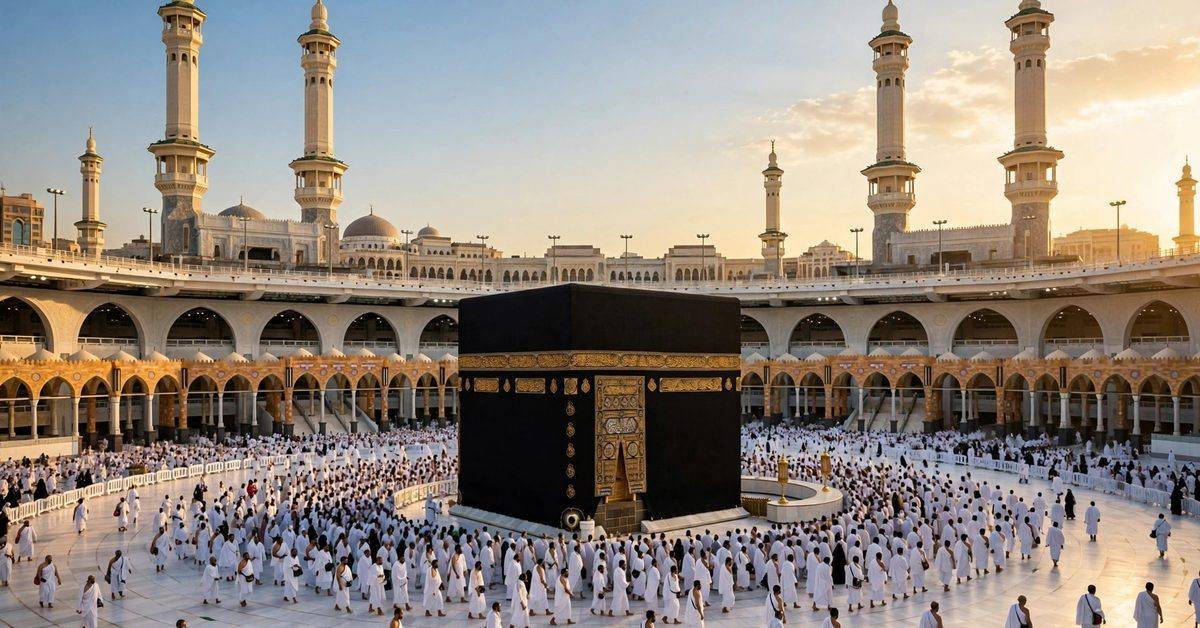
Umrah is the lesser pilgrimage to Makkah — a few hours of worship, possible at any time of the year, that wipes away the sins between one Umrah and the next. Here is exactly how to perform it.
What Is Umrah?
Umrah is a pilgrimage to the Sacred House in Makkah. Unlike Hajj, which is fixed to specific days of Dhul-Hijjah, Umrah can be performed at any time of the year. It has four rites: Ihram, Tawaf, Sa’i, and shaving or trimming the hair. Allah commands it:
وَأَتِمُّوا الْحَجَّ وَالْعُمْرَةَ لِلَّهِ
“Wa atimmul-ḥajja wal-ʿumrata lillāh.”
“And complete the Hajj and Umrah for Allah.” (Surah Al-Baqarah 2:196)
Abu Hurairah (may Allah be pleased with him) reported that the Prophet ﷺ said:
الْعُمْرَةُ إِلَى الْعُمْرَةِ كَفَّارَةٌ لِمَا بَيْنَهُمَا، وَالْحَجُّ الْمَبْرُورُ لَيْسَ لَهُ جَزَاءٌ إِلاَّ الْجَنَّةُ
“Al-ʿumratu ilal-ʿumrati kaffāratun limā baynahumā, wal-ḥajjul-mabrūru laysa lahu jazāʾun illal-jannah.”
“(The performance of) Umrah is an expiation for the sins committed (between it and the previous one). And the reward of Hajj Mabrur (the one accepted by Allah) is nothing except Paradise.” (Sahih al-Bukhari 1773; Sahih Muslim 1349)
Before You Leave
Learn the steps before you travel. Pack your Ihram garments (two plain white unstitched cloths for men; women wear their normal modest clothing), comfortable sandals, and unscented toiletries. Above all, make a sincere intention — Umrah is worship, not a holiday.
Step 1: Enter Ihram and Recite the Talbiyah
Before the Miqat — the boundary around Makkah — make ghusl, put on your Ihram, and pray two rak’ahs. Then make the intention for Umrah: “Labbayk Allahumma Umrah” (Here I am, O Allah, for Umrah). Ihram’s restrictions now apply: no perfume, no cutting hair or nails, and no stitched clothing for men. Then begin the Talbiyah, the call of the pilgrim:
لَبَّيْكَ اللَّهُمَّ لَبَّيْكَ، لَبَّيْكَ لَا شَرِيكَ لَكَ لَبَّيْكَ، إِنَّ الْحَمْدَ وَالنِّعْمَةَ لَكَ وَالْمُلْكَ، لَا شَرِيكَ لَكَ
“Labbayk Allāhumma labbayk, labbayka lā sharīka laka labbayk, innal-ḥamda wan-niʿmata laka wal-mulk, lā sharīka lak.”
“Here I am, O Allah, here I am. Here I am, You have no partner, here I am. Verily all praise, grace and dominion belong to You. You have no partner.”
Keep reciting it on the journey — men aloud, women quietly.
Step 2: Tawaf — Seven Circuits Around the Kaaba
In Masjid al-Haram, begin Tawaf at the Black Stone. Face it, raise your hands and say “Bismillah, Allahu Akbar” — touching or kissing it if you can reach it without pushing, or pointing towards it from a distance. Then walk anticlockwise around the Kaaba, keeping it on your left, for seven circuits — briskly in the first three, for men.
The Prophet ﷺ said: “Tawaf around the House is like prayer, except that you may speak during it. So whoever speaks during it, let him not speak of anything but what is good.” (Jamiʿ at-Tirmidhi 960 — graded sahih by al-Albani)
No dua is fixed for Tawaf — recite Quran, make dua, and remember Allah as you walk. Between the Yemeni Corner and the Black Stone, recite this dua from the Quran:
رَبَّنَا آتِنَا فِي الدُّنْيَا حَسَنَةً وَفِي الْآخِرَةِ حَسَنَةً وَقِنَا عَذَابَ النَّارِ
“Rabbanā ātinā fid-dunyā ḥasanah, wa fil-ākhirati ḥasanah, wa qinā ʿadhāban-nār.”
“Our Lord, give us in this world [that which is] good and in the Hereafter [that which is] good and protect us from the punishment of the Fire.” (Surah Al-Baqarah 2:201)
After the seventh circuit, pray two rak’ahs behind Maqam Ibrahim if possible, then drink Zamzam and make dua.
Step 3: Sa’i — Walking Between Safa and Marwah
At Safa, begin Sa’i. Allah says:
إِنَّ الصَّفَا وَالْمَرْوَةَ مِن شَعَائِرِ اللَّهِ
“Innaṣ-ṣafā wal-marwata min shaʿāʾirillāh.”
“Indeed, as-Safa and al-Marwah are among the symbols of Allah.” (Surah Al-Baqarah 2:158)
On Safa, face the Kaaba, say “Allahu Akbar” three times, then make dua. Walk to Marwah — one length. Men jog lightly between the two green lights. Repeat for seven lengths, finishing at Marwah. No dua is fixed for Sa’i either — pour your heart out to Allah. Sa’i remembers Hajar’s search for water for her son Ismail, a reminder that Allah never abandons those who trust Him.
Step 4: Shave or Trim Your Hair — Umrah Complete
After Sa’i, men shave their heads (the more rewarding option) or trim their hair evenly. Women cut a fingertip’s length from the ends of their hair. With this, you exit Ihram — your Umrah is complete.
3 Common Mistakes First-Timers Make
1. Treating Tawaf like a race. Pushing to kiss the Black Stone harms others — pointing from a distance is enough.
2. Reciting duas from a book without understanding. Your own heartfelt dua beats words you do not understand.
3. Forgetting the intention at the Miqat. Entering Makkah without Ihram means a penalty, so intend before crossing the boundary.
Do Tawaf at quieter times — late at night or after Fajr. Wear broken-in sandals, carry water, and agree on a meeting point with your group. Keep your duas written down. The rites take two to three hours, so rest between them — patience during Umrah is itself worship.
A short journey with an enormous return — sins forgiven, duas answered, a heart renewed. May Allah accept it and invite you again and again.
FAQs
How long does Umrah take?
About two to three hours, depending on crowds — most pilgrims spend several days in Makkah for extra worship.
Can I perform Umrah at any time of the year?
Yes, unlike Hajj, which is fixed to specific days of Dhul-Hijjah — avoid the Hajj days themselves.
Do women need a mahram for Umrah?
Rules depend on your country and current Saudi visa policy — check the latest requirements before booking.
What is the difference between Hajj and Umrah?
Hajj is obligatory once in a lifetime for those who can afford it, performed only in Dhul-Hijjah with extra rites at Mina, Arafat and Muzdalifah; Umrah is a shorter, voluntary pilgrimage any time of the year.
Can children perform Umrah?
Yes — the reward is recorded for them, and the parents also receive reward for taking them.
If you would like a caring teacher to help you or your child read the Quran fluently with Tajweed, book a free trial class with Noor Academy Pakistan today.
Leave a Reply